Showing posts with label Recession. Show all posts

Monday, April 8, 2013

Capitalism is Good for the Environment

Remember the Kyoto Protocol?  It's alright if you don't.  Nobody else seems to.  Which is funny, because "Environmentalists" warned of war, famine, pestilence and death if the world didn't ratify it.  No, seriously.  

Then-VP Al Gore signed the treaty, but the US Senate never ratified it, making it invalid in the US.  Leftists, of course, blamed President Bush, because everything is Bush's fault.  Supposedly, Americans' "Commercialism and greed overcome all common sense and thought for the welfare of future generations. This failure causes hatred not only of the Bush administration, but of American commercialism in general".  Also, the refusal to ratify the Kyoto Protocol was a failure of American leadership in the world.

Sixteen years later, we "greedy" Americans must look more dastardly than ever, right?  Wrong.
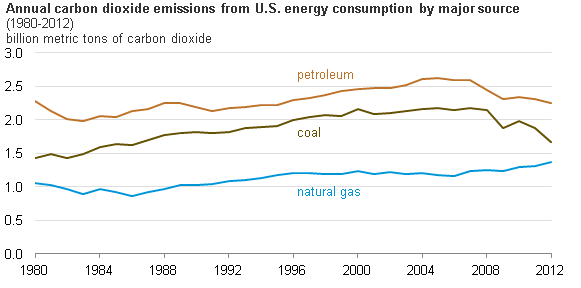
In 2012, a surprising twist and without ever ratifying it, the United States became the first major industrialized nation in the world to meet the United Nation’s original Kyoto Protocol 2012 target for CO2 reductions.
 
How is this possible?  How did we "greedy" Americans succeed in meeting the objectives of the Kyoto Protocol - having never ratified it - while all those virtuous nations that enthusiastically signed the treaty failed?

One word.  Frack.
The largest drop in emissions in 2012 came from coal, which is used almost exclusively for electricity generation (see figure below). During 2012, particularly in the spring and early summer, low natural gas prices led to competition between natural gas- and coal-fired electric power generators. Lower natural gas prices resulted in reduced levels of coal generation, and increased natural gas generation—a less carbon-intensive fuel for power generation, which shifted power generation from the most carbon-intensive fossil fuel (coal) to the least carbon-intensive fossil fuel (natural gas).
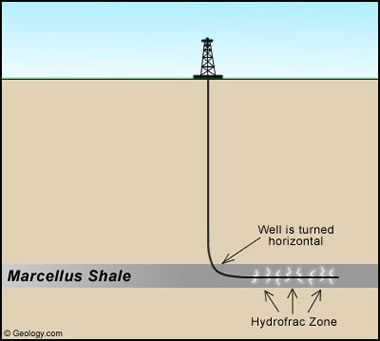
We know that the increased supply of natural gas in the US economy resulted from advances in, and the increased use of, hydraulic fracturing techniques, which unlock reserves that were previously inaccessible.  We also know that hydraulic fracturing (fracking) techniques became economically viable because of the recent increase in energy prices.  Higher prices created an incentive to invest in fracking.  Fracking increased supply, which, along with innovations spurred by competition, resulted in lower natural gas prices, and that prompted energy producers to switch from coal to natural gas.

In other words, free markets succeeded where bloated, collectivist government mandates failed.  In other words, American "greed" turned out to be more virtuous than multinational "virtue". 

There is another, less rosy possible reason why the US's carbon emissions fell since 2007.  The recession began in 2007, and the American economy remains weak.  A weak economy results in reduced energy consumption and demand.  But I don't think that was a major factor here.  After all, Europe's economy is even weaker than that of the US, but all European nations failed to meet their Kyoto goals.

The lesson here is one sensible people learned when they saw the devastation the Soviet Union caused to its environment - free markets work, even in environmental matters.

But don't expect "Environmentalists" to embrace free market solutions to environmental problems.  "Environmentalists" are, for the most part, watermelons - green on the outside, red on the inside.  Environmental concerns are an excuse for them to give government even greater power over people's lives.  No matter how well free market solutions prove to work, most "Environmentalists" will always reject them, because their main concern is not the environment.  Their main concern is bloated, morbidly obese, inescapable government.

Monday, November 19, 2012

California Running Out of Other People's Money

In the past, when I've written about how, "the trouble with Socialism is that eventually you run out of other people's money", I've used Greece as an example.  Although I still think Greece is the best example, several states in the US are doing their best to catch up.  California is arguably in the lead.
The real cause for California's fiscal crisis is simple: They spend too much money. Between 1996 and 2012, the state's population grew by just 15 percent, but spending more than doubled, from $45.4 billion to $92.5 billion (in 2005 constant dollars).

What are Californians getting for all this government spending? According to a new census report released Friday, almost one-quarter, 23.5 percent, of all Californians are in poverty. One-third of all the nation's welfare recipients live in the state, despite the fact that California has only one-eighth of the country's population. That's four times as many as the next-highest welfare population, which is New York [another "Liberal" bastion ~ OS]. Meanwhile, California eighth-graders finished ahead of only Mississippi and District of Columbia students on reading and math test scores in 2011.
Surely, California can solve all its problems by taxing the rich, right?  I mean, that's what Democrats always tell us.  Except, California has already tried that.
Despite Brown's historic tax hike, the California Legislative Analyst's Office announced this week that the state still faces a $2 billion budget deficit just for the next fiscal year. California's liberal electorate has already racked up an additional $370 billion in state and local debt over that last decade. That is more than 20 percent of the state's gross domestic product.

According to the California State Budget Crisis Task Force, that comes to more than $10,000 in debt for every Californian. And because the state's credit rating is so low, California taxpayers must fork over about $2 for every new dollar borrowed. In 2012 alone, the state budget included more than $7.5 billion in debt service -- more than most states' budgets.

Don't think for a second that California's chronic deficits are caused by low taxes. Even before last Tuesday's tax hikes, California had the most progressive income tax system in the nation, with seven brackets, and the second-highest top marginal rate. Now it has the nation's highest top marginal rate and the nation's highest sales tax. And the budget still isn't balanced.
What do Californians do when fed up with excessive taxation, regulation and debt?  Move to Texas.
Middle-class families that want actual jobs, not welfare, are fleeing California in droves. According to IRS data compiled by the Manhattan Institute, since 2000, almost 2 million Americans have left California for other states. Their most popular destination: Texas.

It isn't a tough move to make. Thanks to low taxes and simple regulations, Chief Executive magazine ranked Texas as the best state to do business in for 2012. Guess who ranked dead last? That's right, California. And not only does Texas (6.8 percent) have a far lower unemployment rate than California (10.2 percent), but, according to the Census Bureau, income inequality is worse in California than it is in Texas.
Again, this is a case of federalism at work.  States with low taxes, light regulation and a business friendly climate attract businesses (duh!), which create jobs, which attract people.  The opposite is also true.

From the Manhattan Institute's Civic Report of September 2012.
Note how the top "sender states" - the ones people are leaving in droves - are "Liberal" bastions, while the top destination states - the ones to which people and businesses are escaping - are largely Conservative.  This shouldn't surprise anyone.

What makes matters worse for California is that when they push people out of their state, those people take their money with them (duh!), which shrinks California's tax base.  California isn't just losing people to other states, it's losing money.

From the Manhattan Institute's Civic Report of September 2012.

So, California keeps raising tax rates on a smaller number of people, which causes more people to move out, which shrinks the state's tax base, so they raise tax rates...

California really should be the #1 place to live in the US.  The state's natural beauty, raw materials (petroleum and natural gas abound), fertile soil and weather should make it a great place to live and do business.  Instead, California's politicians, elected by California's people, keep making it increasingly difficult to make a living, so people move to Texas, where doing business is much easier.

So, which model do you think the US as a whole is currently following; California or Texas?  Which model should we follow?

Saturday, November 17, 2012

Saudi Dakota? (Updated)

The US economy may be stagnant, but North Dakotans haven't noticed.  Recession?  What recession?
The “Economic Miracle State” continues to lead the nation with the lowest state unemployment rate at 3% in September, at almost five percentage points below the national average of 7.8%.  There were 11 North Dakota counties with jobless rates below 2.0% in September, and Williams County, which is at the epicenter of the Bakken oil boom, continues to boast the lowest county jobless rate in the country at just 0.7%.  The exponential growth in North Dakota oil production has fueled exponential growth in the state’s oil and gas jobs, which have more than tripled over the last three years.  Overall employment throughout the entire state increased 5.6% over the twelve month period through September; four times the tepid 1.4% pace of job growth nationally during that period.
It ain't no miracle.  It's a deliberate decision to allow free market forces to work and create wealth by accessing the state's natural raw materials, namely petroleum.
What’s especially impressive is the incredible exponential increase in North Dakota’s oil production over such a short period of time.  The state’s oil production has doubled in just the last 16 months, from 364,160 bpd in May of last year to 728,494 in September of this year.  Oil coming out of the state’s Bakken Formation is behind the huge increase, as that oil field in western North Dakota now supplies 91% of the state’s oil, up from only 78% of the state’s oil two years ago.  Bakken oil output has doubled in just the last 15 months, from 320,435 bpd last June to 662,428 bpd in September (see bottom chart above).  At the current pace of production increases, North Dakota’s oil production will surpass one million bpd by the end of next year.  And it’s the exponential increases in shale oil production in the Bakken region of North Dakota and the Eagle Ford Shale region of Texas that have the United States on a trajectory to become the world’s largest oil producer in the next eight years.


Considering North Dakota's economic boom due to "frackin' the Bakken", and that the US has more petroleum in the Green River Formation than all the world's known oil reserves, the federal government must be eager to allow more drilling and exploration on federal lands, right?

The Interior Department on Friday issued a final plan to close 1.6 million acres of federal land in the West originally slated for oil shale development.

The proposed plan would fence off a majority of the initial blueprint laid out in the final days of the George W. Bush administration. It faces a 30-day protest period and a 60-day process to ensure it is consistent with local and state policies. After that, the department would render a decision for implementation.
As I wrote before, "it's not as though, in this roaring economy, we need all that inexpensive energy or high-paying jobs".

The US is over $16,000,000,000,000 in debt and counting.  The federal government added over $120,000,000,000 to that debt in October 2012 alone and is on track to add another $1,320,000,000,000 to the debt by the end of fiscal year 2013.  Raising taxes will likely cause the economy to slow even more.  Even if the federal government were to cut spending drastically (good luck with that), we would need enormous economic growth to begin paying down our monstrous debt.

In other words, we need the kind of growth North Dakotans have enjoyed for years.

UPDATE (19NOV2012): The following charts demonstrate how hydraulic fracturing (fracking) has increased total US reserves of petroleum and natural gas by making previously unavailable reserves available.  Further technological advances will make the Green River Formation available.

From the Energy Information Administration

Wednesday, November 14, 2012

October Deficit = $120 Billion

Technically, the federal government doesn't have a budget deficit, because in order to have a budget deficit, one first needs a budget.  And we haven't had one of those since 2009.  In more practical terms however, the federal government spent $120 Billion more than it took from tax payers in October 2012, the first month of fiscal year 2013.
The Treasury said on Tuesday the October deficit was $120 billion, larger than economist forecasts for a $114 billion gap and up from $98 billion in October of 2011.
And it's not as though they took less money from tax payers.
Growth in expenditures outpaced rising receipts, deepening the deficit. Outlays grew to $304 billion from around $262 billion in the same month last year while receipts rose to $184 billion from $163 billion.
Got that?  The more DC takes the more DC spends. 

Remember when Pres Obama promised...
...today I’m pledging to cut the deficit we inherited in half by the end of my first term in office. This will not be easy. It will require us to make difficult decisions and face challenges we’ve long neglected. But I refuse to leave our children with a debt that they cannot repay — and that means taking responsibility right now, in this administration, for getting our spending under control.
In case you haven't heard, that didn't happen.  Instead, our federal government ran without a budget for three years, spent over $1,100,000,000,000 more than it took each year for four years straight, and added $5,000,000,000,000 to the national debt in those four years.

And it's on track to do it again. 

And it'll be George Bush's fault.

Tuesday, November 13, 2012

Which States Are Best for Jobs?

With thanks to Keith Bloom.

Federalism is part of the genius of the Constitution, which gives the federal government very clear, limited powers, and leaves all other "rights and powers" in the hands of "the people and the various states".  All states face similar problems; crime, unemployment, natural disasters, etc.  But each state devises different solutions to those problems.  Some work better than others.  Some are worse than the problems they're supposed to fix.

When one states' solution works well, other states follow suit, although usually with local variations.  When a solution fails miserably, the smart states learn from their neighbors' mistakes and stay away.  States are also more responsive to their residents than is the federal government, mostly because they have fewer people to please. 

Finally, if a person is unhappy with his/her state, at worst they can move to a state they think does things better, which is a whole lot easier than moving to another country.  Trust me.  I've done both.

And that is what makes Federalism work; competition between states. 

One area in which states compete is the job market.  Some states make it easier than others for businesses to create jobs, which means more businesses move to those states, which means more people move to those states looking for work.  Which states make it easiest for businesses to create jobs?

40% of the US population created 75% of new jobs.
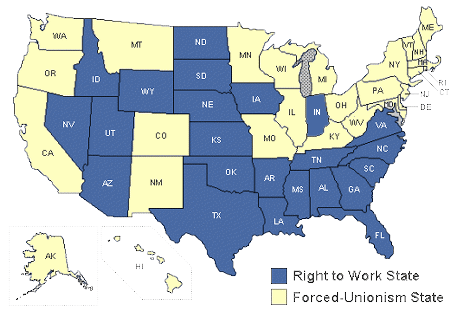
 Since the recession ended in June 2009, almost three out of every four jobs added to U.S. payrolls have been in Right to Work states (1.86 million out of 2.59 million), even though those 22 states represent only 38.8% of the U.S. population (120 million).  In contrast, only about one of every four new jobs were created in forced-unionism states (730,000), even though more than 61% of Americans live in those 28 states (189 million).  Relative to their population, the Right to Work states have been job-creating powerhouses during the recovery, and forced union states haven’t even come close to “carrying their weight” in terms of their share of the population.  Adjusting for differences in population, Right to Work states created four new jobs for every one job added in forced union states, because those 21 RTW states created 2.54 times more jobs even though forced union states have 1.6 times as many people.
That means that, since June 2009, 40% of the population created about 75% of the new jobs in the US.  So, which are these right-to-work, job-creating power houses?
States with right-to-work laws, and forced union membership laws.

You know what?  That map looks kind of familiar.  It looks a lot like the map of...

States with Republican (red) and Democrat (blue) governors since 2010.

State legislatures by political party
So, is there a correlation between a business-friendly climate and job growth?  If so, which party's policies lead to the most job growth?  Judge for yourself.
Here are the top 20 most-friendly business states according to CNBC:

1.Texas
2.Utah
3.Virginia
4.North Carolina
5.North Dakota
6.Nebraska
7.South Dakota
8.Colorado
9.Georgia
10.Wyoming
11.Minnesota
12.Iowa
13.Idaho
14.Indiana
15.Kansas
16.Tennessee
17.Wisconsin
18.Oregon
19.New Hampshire
20.Arkansas
So, naturally, American voters elected a president with a similar pro-growth, pro-jobs agenda, right?  Not really.
President Obama, speaking at an AFL-CIO conference in April this year, “I believe when folks try to take collective bargaining rights away by passing so-called right-to-work laws, which might also be called ‘right-to-work for less’ laws, that’s not about economics, that’s about politics.”
 Is it any wonder the US economy has been stagnant since 2009?  Pres Obama should thank all those Republican governors and legislators, because without them, he'd have no "jobs created or saved" to brag about.

Ronald Reagan said that "the best social program is a job".  He was absolutely right.  Government welfare programs don't lift people out of poverty.  Jobs do.  Businesses create jobs.  Demonizing businesses and weighing the down with excessive regulation and taxation doesn't work.

But Republican-led states demonstrate what does.

Sunday, November 11, 2012

Energy: Told You So

Pres Obama likes to take credit for the increase in petroleum and natural gas production in the US over the last four years.  What he leaves out is that, as Mitt Romney pointed out during the debates, the Obama administration cut drilling permits on federal lands by 36%.  The increase comes from private and (some) state lands.  Now that he doesn't need to run for re-election, Pres Obama plans to cut federal drilling permits even further.
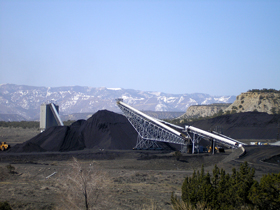
The Interior Department on Friday issued a final plan to close 1.6 million acres of federal land in the West originally slated for oil shale development.

The proposed plan would fence off a majority of the initial blueprint laid out in the final days of the George W. Bush administration. It faces a 30-day protest period and a 60-day process to ensure it is consistent with local and state policies. After that, the department would render a decision for implementation.
It's not as though, in this roaring economy, we need all that inexpensive energy or high-paying jobs.  In fact, it's probably a good thing that the layoffs have already started in the icky energy sector.
A Utah coal company owned by a vocal critic of President Barack Obama has laid off 102 miners.

The layoffs at the West Ridge Mine are effective immediately, according to UtahAmerican Energy Inc., a subsidiary of Murray Energy Corp. They were announced in a short statement made public Thursday, two days after Obama won re-election.

The layoffs are necessary because of the president's "war on coal," the statement said. The slogan is one used frequently during the election by Murray Energy CEO Robert Murray, who was an ardent supporter of Republican presidential candidate Mitt Romney.

In its statement, UtahAmerican Energy blames the Obama administration for instituting policies that will close down "204 American coal-fired power plants by 2014" and for drastically reducing the market for coal.
"There is nowhere to sell our coal, and when we can, the market prices are far lower," the statement said. "Without markets, there can be no coal mines and no coal jobs."
Then-Sen Obama did promise in January 2008 that his policies would "bankrupt" coal power plants and cause energy prices to "necessarily skyrocket".  So credit him with one promise kept.

Friday, November 9, 2012

Running Out of Other People's Money

Margaret Thatcher famously said that "the problem with Socialism is that eventually you run out of other people's money".  She didn't say what happens then.  Greece gives us an idea.
Private businesses have closed down in the thousands. Unemployment stands at a record 25 percent, with more than half of Greece's young people out of work. Caught between plunging incomes and ever increasing taxes, families are finding it hard to make ends meet. Higher heating fuel prices have meant many apartment tenants have opted not to buy heating fuel this year. Instead, they'll make do with blankets, gas heaters and firewood to get through the winter. Lines at soup kitchens have grown longer.
But at least Greeks are pulling together in hard times, right?
Life in Athens is often punctuated by demonstrations big and small, sometimes on a daily basis. Rows of shuttered shops stand between the restaurants that have managed to stay open. Vigilantes roam inner city neighborhoods, vowing to "clean up" what they claim the demoralized police have failed to do. Right-wing extremists beat migrants, anarchists beat the right-wing thugs and desperate local residents quietly cheer one side or the other as society grows increasingly polarized.
.....
After battering his Egyptian assistant, the mob turned on Mr Abdulbasset, who had defied police to keep his shop open...  The riot police watched on but did not intervene
The authorities will take care of all this vigilante justice, right?
Greece's sclerotic justice system has been hit by a protracted strike that has left courts only functioning for an hour a day as judges and prosecutors protest salary cuts.

At least if they get beat up, Greeks still have "universal", government-provided medicine, right?
A sign taped to a wall in an Athens hospital appealed for civility from patients. "The doctors on duty have been unpaid since May," it read, "Please respect their work."
.....
"When the pharmacies are closed and I can't get my insulin, which is my life for me, what do I do? ... How can we survive?" asked Voula Hasiotou, a member of an association of diabetics who turned out for the rally.
Keep all this in mind when politicians tell you we need to keep borrowing over $1 Trillion per year, as we have during all four years of Pres Obama's first term. 

Think this can't happen in the US?  On the contrary, there's no reason why it can't.  And if we let it happen, it'll be far worse.  The US and EU bailed Greece out.  Our population is 31x bigger than that of Greece, and our economy is the biggest in history.  No one is big enough to bail us out.

Here's one last quote from the AP article on Greece.
"Our society is on a razor's edge," Public Order Minister Nikos Dendias said recently, after striking shipyard workers broke into the grounds of the Defense Ministry. "If we can't contain ourselves, if we can't maintain our social cohesion, if we can't continue to act within the rules ... I fear we will end up being a jungle."
Not even close, Mr Dendias.  Greece is following the eternal cycle.  From oppression to revolution, from revolution to freedom, from freedom to prosperity, from prosperity to entitlement and indolence, from entitlement and indolence to anarchy, and finally from anarchy to dictatorship and oppression.

And we're heading in the same direction.

Wednesday, November 7, 2012

Democrats' Plan for the Debt Crisis

I've asked this question of several "Liberals" and, so far, received exactly zero answers.  What is the Democrats' plan to avert America's approaching debt crisis?  Does anyone out there have an answer?  Anyone?  Bueller?

Here's a little background.
Treasury Secretary Timothy Geithner told the House Budget Committee Thursday that President Obama’s fiscal year 2013 budget — “the most expensive in United States history” — would “put the U.S. on an ‘unsustainable’ course” if enacted.

Geithner also told committee Chairman Paul Ryan that although the Obama administration doesn’t have a “definitive solution” to the debt crisis, it definitely knows it doesn’t like the Republican solution. ...

“We have millions of Americans retiring every day, and that will drive substantially the rate of growth of health care costs. You are right to say we’re not coming before you today to say we have a definitive solution to that long-term problem. What we do know is, we don’t like yours,” Geithner said.

Sunday, April 29, 2012

The Road We Really Traveled

President Obama's 8-minute re-election infomercial, produced by Davis Guggenheim (Waiting for Superman, An Inconvenient Truth) and narrated by Tom Hanks, gets the Mystery Science Theater 3000 and Pop-Up Video treatment (simultaneously!) from Andrew Klavan and Bill Whittle.

Thursday, April 26, 2012

Why Democrats Refuse to Do Their Job

Speaking of infuriating enlightenment, watch DNC chair Debbie Wasserman Schultz (D-FL) explain why Democrats in Congress have refused to do their job for almost 2,000 days.  Warning: you may want to have a barf bag handy.


Nauseating, isn't she?  Don't you wish you could simply refuse to do your job and continue to collect a fat paycheck and lavish benefits and perks?  Probably not.  You're probably a decent person.

Thursday, April 19, 2012

You Tax Dollars (Not) at Work

Take a look at this picture of yesterday's Senate Budget Committee meeting.

Note that one side of the table is full, while the other is empty.  The empty chairs belong to Democrats on the Committee.

It's been 1,087 days since Congress has passed a budget.  In case you didn't know, writing, voting on and passing a budget for the Federal Government is one of the fundamental functions of Congress.  In fact, Federal law (written, voted on and passed by Congress) requires Congress to pass a budget by 15 April each year.  Congress has violated this law since 2010.

Why hasn't Congress passed a budget?  Democrats refuse to even try.  As the photo illustrates, they don't even bother to show up to budget meetings.  Democrats claim the reason they haven't attempted to pass a budget is because Senate Republicans will filibuster, which is, of course, a lie.  Under Senate rules, budget votes are not subject to filibuster.  Are Democrats ignorant of Senate rules, or do they bet that the people who voted them into office are stupid enough to believe the lie?

The question pretty much answers itself, doesn't it?

Please remember, ladies and gentlemen, you provide these people's salaries, their pensions, their security details and all the perks that accompany a seat in Congress, and if you're an average American, their salaries, pensions and perks make yours look like pocket change.

Now ask yourselves this question; what would happen to you if you refused to do your job for 1,087 days?  Would you keep your job and all its benefits?

Again, the question pretty much answers itself, doesn't it?

Why aren't more Americans outraged over this?  What is wrong with the average American that, first, they elected these people to office, then allowed them to stay there?

Here's a list of the Senate Budget Committee members who didn't even bother to show up for work.

(1)   DSCC Chair Patty Murray (D-WA)
(2)   Sen. Ron Wyden (D-OR)
(3)   Sen. Bill Nelson (D-FL)
(4)   Sen. Debbie Stabenow (D-MI)
(5)   Sen. Ben Cardin (D- MD)
(6)   Socialist Sen. Bernie Sanders (I-VT)
(7)   Sen. Mark Warner (D-VA)
(8)   Sen. Jeff Merkley (D-OR)
(9)   Sen. Mark Begich (D-AK)
(10) Sen. Chris Coons (D-DE)
(11) Sen. Sheldon Whitehouse (D-RI)

If your Senator is on this list, do something about it.

Monday, March 19, 2012

Fisker Karma: Your Tax Dollars at Work

Recently, I wrote about the Obama Administration's wasteful "investing" of billions of dollars into unproductive "green" business ventures.  To be clear, I oppose all government subsidies for private businesses.  Government inherently "invests" in failure, because when a business is successful, there's no need for government to prop it up with tax money.  A successful business's profits keep it afloat just fine.  That begs the question; why would we want government to prop up a failing business?  Answer; we don't.  So why do we citizens continue to allow it?

One of those businesses is Fisker, makers of the Karma, a luxury electric car with a range-extending, four cylinder, turbocharged generator made by another failed business in which the Obama Administration invested; GM.  Consumer Reports bought a Karma for $108,000 for testing and immediately had serious trouble with it.  After a trip to the dealership, CR finally got their car back, completed their road test report and found that many other customers are having similar issues.  Video and some text follow.


Normally when we have a car like this at our test facility, it has no problem accumulating break-in miles. After all, big luxury sedans lend themselves to road trips. But the Fisker is languishing in our lot, going out mostly for short commutes that remain well within cell-phone coverage in case of trouble--a concern in the rural area surrounding our track. Just this weekend, for example, the speedometer and energy meter display disappeared when driving, on top of having several other rogue warning indicators appear last week. It is expected we'll be revisiting the dealership soon. We've had cars in the past that have been troublesome, but never anything like this. 
From CR's report on customer issues:

Reading comments on our recent blogs, posts to owner forums, and searching the National Highway Traffic Safety Administration (NHTSA) complaints database, we have found several notable issues reported. While there are not a high number of complaints, it does show we are not alone. And remember, there have been only about 500 cars sold, according to Fisker, and the owners skew to the affluent, meaning the Karma is not the typical owner's only car and miles have likely been modest thus far.
Examples of complaints include:
My Karma (with less than a thousand miles on it) had a mysteriously worn-down coupling between one of the motors and the wheels. This will require a completely new differential. As of today... my Karma [has been] "in the shop" longer than I have driven the car. And the prospect of having it in the shop for another 2 weeks (or possibly longer) is making me really unhappy...
Great.  So the Obama Administration spent half a billion of your dollars and mine to subsidize a lemon for exceptionally wealthy people who want to be absolved of their sins against Gaia.

Again, if Pres Obama and his worshipers want to waste their own money on a venture like this, that's their problem.  But I don't have a lot of disposable income to flush down the "green" toilet.  Do you?

Saturday, March 17, 2012

Lying About Petroleum

Yesterday, I pointed out how Pres Obama lies about the amount of petroleum we have right here in the US.  Investors Business Daily had already pointed out that fact earlier this week.

When he was running for the Oval Office four years ago amid $4-a-gallon gasoline prices, then-Sen. Barack Obama dismissed the idea of expanded oil production as a way to relieve the pain at the pump. 
"Even if you opened up every square inch of our land and our coasts to drilling," he said. "America still has only 3% of the world's oil reserves." Which meant, he said, that the U.S. couldn't affect global oil prices. 
It's the same rhetoric President Obama is using now, as gas prices hit $4 again, except now he puts the figure at 2%. 
"With only 2% of the world's oil reserves, we can't just drill our way to lower gas prices," he said. "Not when we consume 20% of the world's oil." 
But the figure Obama uses — proved oil reserves — vastly undercounts how much oil the U.S. actually contains. In fact, far from being oil-poor, the country is awash in vast quantities — enough to meet all the country's oil needs for hundreds of years. 
The U.S. has 22.3 billion barrels of proved reserves, a little less than 2% of the entire world's proved reserves, according to the Energy Information Administration. But as the EIA explains, proved reserves "are a small subset of recoverable resources," because they only count oil that companies are currently drilling for in existing fields.
When you look at the whole picture, it turns out that there are vast supplies of oil in the U.S., according to various government reports.
Contrary to Pres Obama's dire estimate, various federal agencies, (including the US Geological Survey, as I pointed out yesterday), the US contains over 1.5 trillion barrels of recoverable petroleum.

Again, these are Federal Government reports.  Is Pres Obama not a member of the Federal Government?  Are these reports unavailable to Pres Obama, but available to me and IBD?  Is Pres Obama incapable of reading them?

So, Obamaphiles, is your messiah lying to you, or is he ignorant?  Because those are the only two possible reasons he keeps repeating the 2% myth.  So, which is it?

Thursday, February 9, 2012

Making Things Worse (Continued)

Recently I posted empirical evidence that Pres Obama, far from saving us from economic Armageddon as his worshipers claim, actually made things worse through bad policy.  This time we'll take a look at one of those bad policies and its outcomes (so far).

Before Obamaphiles get in too big a tizzy, let's all acknowledge that then-Senator Obama actually warned us back in January 2008 that his policies would do exactly that.


Everything - absolutely everything - we do in the economy requires energy, so if energy prices "necessarily skyrocket", that would obviously choke off economic growth.  One way to decrease the price of energy is to increase supply.  And that's exactly what Pres Obama prevented by denying the construction of the Keystone XL Pipeline Expansion from Alberta to Texas.
President Obama, denouncing a “rushed and arbitrary deadline” set by congressional Republicans, announced Wednesday that he was rejecting a Canadian firm’s application for a permit to build and operate the Keystone XL pipeline, a massive project that would have stretched from Canada’s oil sands to refineries in Texas.
Yeah.  "Rushed and arbitrary".  He only had over two years to make a decision.  In fact, he made the decision over the objections of his own "Jobs Council". 
Continuing to deliver inexpensive and reliable energy,” the council reported, “is going to require the United States to optimize all of its natural resources and construct pathways (pipelines, transmission and distribution) to deliver electricity and fuel.” 
It added that regulatory “and permitting obstacles that could threaten the development of some energy projects, negatively impact jobs and weaken our energy infrastructure need to be addressed.”  
 Duh.  Seems pretty obvious, doesn't it?  Not if your name is Obama, apparently.

Who gets hurt worst by "skyrocketing" energy prices?  Obviously, poor people do.

“Lower-income families are more vulnerable to energy costs than higher-income families because energy represents a larger portion of their household budgets,” according to the study, which relied on Energy Information Administration data. 
Energy costs this year will represent 24 percent of after- tax income for families earning $10,000 to $30,000, up from 14 percent in 2001. Families with after-tax income from $30,000 to $50,000 will spend 7 percent of their earnings on electricity, according to the study.
Why does Pres Obama  hate poor people? 


But hey, at least Pres Obama's billionaire patron, Warren Buffet, benefited from it.
As it turns out, oil is already moved from northern latitudes, such as the booming oil fields of North Dakota, down to the Gulf of Mexico by rail of the old, low-speed variety.
As it happens, 75 percent of the oil currently shipped by rail out of North Dakota is handled by Burlington Northern Santa Fe LLC… which just happens to be a unit of Warren Buffett’s company, Berkshire Hathaway Inc.  What a coincidence! 
And now the Chinese will benefit from Pres Obama's decision.
The prospect of Canada entering free-trade talks with China is suddenly being discussed, as Chinese leaders indicated during Prime Minister Stephen Harper's visit that they are prepared to head down that path — even though Canadian officials aren't so sure this country is ready for the jump. 
The development came as China and Canada declared Thursday that bilateral relations have reached "a new level" following a series of multibillion-dollar trade and business agreements to ship additional Canadian petroleum, uranium and other products to the Asian superpower

To make matters worse, while Pres Obama dithered for two years, refusing to make a decision on a privately-funded project that would obviously generate tens of thousands of jobs (no big deal, according to Democrats) and help boost the economy, Pres Obama spent billions of tax payer dollars on "green" tech failures like Solyndra and Fisker.

So, Obamaphiles; still insist that The One rescued us from the next Great Depression?  Of course you do!  Your adoration was never based on facts, reason or logic, after all.

Saturday, February 4, 2012

Making Things Worse

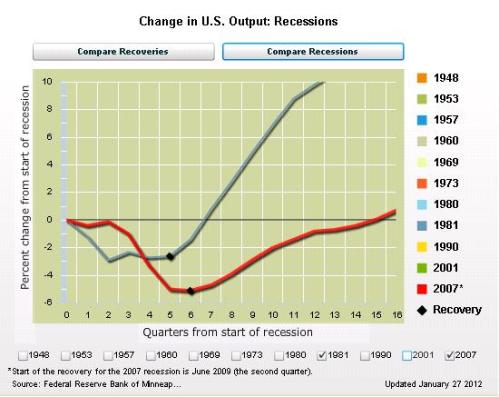
Back in December 2011, I used data from the Minneapolis Federal Reserve to demonstrate how Pres Obama's policies have made this economic recovery much weaker and slower than past ones.
Since World War II, the economy rebounded at a rate generally proportional to the recession that preceded the recovery.  But not this time.  This time, the downturn was steep, but the "recovery" has been shallow and slow.
Dan Mitchell of the Cato institute did something similar a year ago, and revisited the issue more recently.  The difference is that he compared Pres Obama's weak recovery only to Pres Reagan's much, much stronger recovery.
Those two charts showed that the current recovery was very weak compared to the boom of the early 1980s.
But perhaps that was an unfair comparison. Maybe the Reagan recovery started strong and then hit a wall. Or maybe the Obama recovery was the economic equivalent of a late bloomer So let’s look at the same charts, but add an extra year of data. Does it make a difference?  Meh…not so much. 


As you can see, the Reagan recovery didn't just rebound in proportion to the recession, it actually exceeded the trajectory of the recession.  In fact, it was literally off the charts.  Mitchell points to a Wall Street Journal article that expounds on the difference between the two recoveries.
If in this “recovery” our economy had grown and generated jobs at the average rate achieved following the 10 previous postwar recessions, GDP per person would be $4,528 higher and 13.7 million more Americans would be working today. …President Ronald Reagan’s policies ignited a recovery so powerful that if it were being repeated today, real per capita GDP would be $5,694 higher than it is now—an extra $22,776 for a family of four. Some 16.9 million more Americans would have jobs.
Mitchell then points out that Pres Obama didn't cause the recession, but he's continued - and even worsened - the bad policies that did cause it.
  • Bush increased government spending. Obama has been increasing government spending.
  • Bush adopted Keynesian “stimulus” policies. Obama adopted Keynesian “stimulus” policies.
  • Bush bailed out politically connected companies. Obama has been bailing out politically connected companies.
  • Bush supported the Fed’s easy-money policy. Obama has been supporting the Fed’s easy-money policy.
  • Bush created a new healthcare entitlement. Obama created a new healthcare entitlement.
  • Bush imposed costly new regulations on the financial sector. Obama imposed costly new regulations on the financial sector.
Is this the Hope'n'Change(TM) you voted for, Obamaphiles?  Face it.  Empirical evidence proves that Pres Obama made things worse by doubling down on the bad policies that caused the recession in the first place.

Finally, Mitchell ends with this very good point.
This is why I always tell people not to pay attention to party labels. Bigger government doesn’t work, regardless of whether a politician is a Republican or Democrat. The problem isn’t Obamanomics, it’s Bushobamanomics. But since that’s a bit awkward, let’s just call it statism.
True, and that's what scares me.  All Democrats are statists, but the vast majority of Republicans are too.

Saturday, December 24, 2011

Bill Whittle: Three Years of Obama

Illuminating economic charts of 2011

The American Enterprise Blog shares the seven economic charts of 2011 they believe are the most enlightening.  I would have included this one...


which helps explain this one.


This is their number one pick, and it's a good one..


We who opposed President Obama's "recovery" "plan" need to keep presenting this one over and over through the election. 

Saturday, December 17, 2011

What Deregulation?

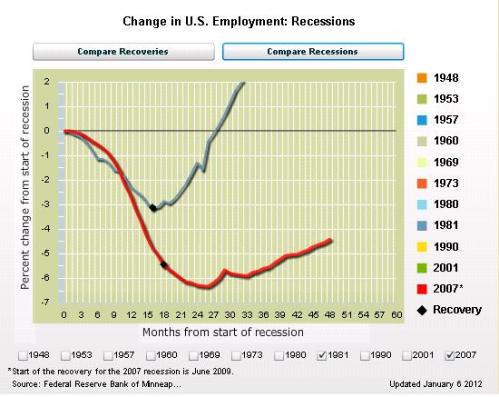
What is slowing the economy's rate of recovery?  Since World War II, the economy rebounded at a rate generally proportional to the recession that preceded the recovery.  But not this time.  This time, the downturn was steep, but the "recovery" has been shallow and slow.  See this page from the Minneapolis Federal Reserve for a series of helpful comparison charts.

The red line refusing to curve back upward is the current recession, which began in 2007.

So, what's weighing down the recovery?  Republicans claim excessive regulation is the problem.  Democrats claim that couldn't possibly be true.  From the Wall Street Journal:
 Jan Eberly, an Assistant Treasury Secretary, kicked off the Administration campaign with a white paper in October that purported to debunk the "misconceptions" that "uncertainty is holding back business investment and hiring and that the overall burden of existing regulations is so high that firms have reduced their hiring." Then the Administration mobilized some of the worst offenders, such as Kathleen Sebelius of HHS ("There has been no explosion of new rules") and Lisa Jackson of the EPA (her opponents are "using the economy as cover").
So who is right?  To answer that question, we first must ask if the number of regulations has increased in the last few years. Has it? The chart at the left presents the number of regulations being proposed or added each year.  A few things to note here.  First, not every regulation proposed ends up on the books, but many do.  Second, each of these regulations, when enacted, weighs the economy down by a minimum of $100 million per year.  Third, this chart does not include all the regulations that cost less than $100 million per year, but still add weight.  Fourth, these are only the regulations being added to an already bloated regulatory system, and old regulations never seem to come off the books.

Maybe all these regulations aren't the only reason the recovery has progressed so slowly, but how could they possibly have zero effect?