Federalism is part of the genius of the Constitution, which gives the federal government very clear, limited powers, and leaves all other "rights and powers" in the hands of "the people and the various states". All states face similar problems; crime, unemployment, natural disasters, etc. But each state devises different solutions to those problems. Some work better than others. Some are worse than the problems they're supposed to fix.
When one states' solution works well, other states follow suit, although usually with local variations. When a solution fails miserably, the smart states learn from their neighbors' mistakes and stay away. States are also more responsive to their residents than is the federal government, mostly because they have fewer people to please.
Finally, if a person is unhappy with his/her state, at worst they can move to a state they think does things better, which is a whole lot easier than moving to another country. Trust me. I've done both.
And that is what makes Federalism work; competition between states.
One area in which states compete is the job market. Some states make it easier than others for businesses to create jobs, which means more businesses move to those states, which means more people move to those states looking for work. Which states make it easiest for businesses to create jobs?
That means that, since June 2009, 40% of the population created about 75% of the new jobs in the US. So, which are these right-to-work, job-creating power houses?
Since the recession ended in June 2009, almost three out of every four jobs added to U.S. payrolls have been in Right to Work states (1.86 million out of 2.59 million), even though those 22 states represent only 38.8% of the U.S. population (120 million). In contrast, only about one of every four new jobs were created in forced-unionism states (730,000), even though more than 61% of Americans live in those 28 states (189 million). Relative to their population, the Right to Work states have been job-creating powerhouses during the recovery, and forced union states haven’t even come close to “carrying their weight” in terms of their share of the population. Adjusting for differences in population, Right to Work states created four new jobs for every one job added in forced union states, because those 21 RTW states created 2.54 times more jobs even though forced union states have 1.6 times as many people.
40% of the US population created 75% of new jobs.

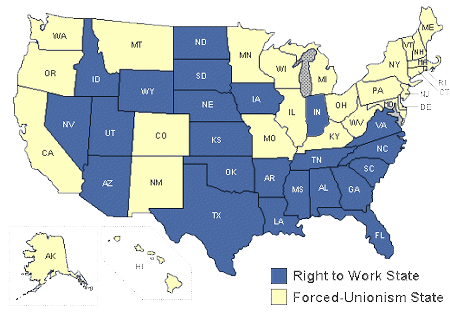 |
| States with right-to-work laws, and forced union membership laws. |
You know what? That map looks kind of familiar. It looks a lot like the map of...
 |
| States with Republican (red) and Democrat (blue) governors since 2010. |
 |
| State legislatures by political party |
Here are the top 20 most-friendly business states according to CNBC:So, naturally, American voters elected a president with a similar pro-growth, pro-jobs agenda, right? Not really.
1.Texas
2.Utah
3.Virginia
4.North Carolina
5.North Dakota
6.Nebraska
7.South Dakota
8.Colorado
9.Georgia
10.Wyoming
11.Minnesota
12.Iowa
13.Idaho
14.Indiana
15.Kansas
16.Tennessee
17.Wisconsin
18.Oregon
19.New Hampshire
20.Arkansas
President Obama, speaking at an AFL-CIO conference in April this year, “I believe when folks try to take collective bargaining rights away by passing so-called right-to-work laws, which might also be called ‘right-to-work for less’ laws, that’s not about economics, that’s about politics.”Is it any wonder the US economy has been stagnant since 2009? Pres Obama should thank all those Republican governors and legislators, because without them, he'd have no "jobs created or saved" to brag about.
Ronald Reagan said that "the best social program is a job". He was absolutely right. Government welfare programs don't lift people out of poverty. Jobs do. Businesses create jobs. Demonizing businesses and weighing the down with excessive regulation and taxation doesn't work.
But Republican-led states demonstrate what does.

No comments:
Post a Comment