Do watch the whole thing, but a couple things stood out to me.
First, the fracking revolution could have just as easily taken place in Russia, China, or a number of other places, but instead it happened in the US. One reason for that is stronger property rights in the US than in other countries. Most fracking in the US takes place om privately owned land. In most states, the land owner also owns the mineral rights for his/her land. That means they can make more money from allowing a fracking firm to drill on their land, which gives the land owner more incentive to do so.
It's a great example of how liberty leads to opportunity, which leads to prosperity.
Second, oil giants like ExxonMobil did not initiate the fracking boom. Smaller firms, whose wells were drying up and didn't have the resources to explore abroad, were more willing to take risks because, essentially, they had nothing to lose.
Anti-fracking regulations "Liberals" demand wouldn't hurt ExxonMobil, but they would kill those smaller firms.
Unfortunately, no discussion on hydraulic fracturing is complete without addressing anti-fracking hysteria. It's worth noting, then, that former DOE secretary Stephen Chu, no fan of fossil fuels, stated that fracking...
...is something you can do in a safe way,” former Secretary of Energy Steven Chu said while speaking in Columbus, Ohio, on Sept. 18. He also said that it was a “false choice” to say that the country can either preserve the environment or acquire cheap natural gas.
“I would say to everybody that hydraulic fracking is safe,” Salazar said during a conference in Las Cruces, N.M. He said that fracking was “creating an energy revolution in the United States.”
Chu and Salazar joined current Secretary of Energy Ernest Moniz, who in early September praised fracking as “a big contributor to our carbon reduction” and “a huge economic benefit.”
“There are risks but they can all be mitigated” through monitoring and regulation, Neil Dhot, a spokesman in London, said today by telephone. The report, compiled by an independent consultant, is funded by the water industry, he said.
Everything we do involves risk - even doing nothing. An honest risk analysis of hydraulic fracturing, I believe, demonstrates that the financial benefits of fracking far outweigh the potential risks.
The growth of crude oil production in the Bakken region is part of a longer-term trend in drilling efficiency gains and has led North Dakota to rank second in crude oil production in the United States, behind only Texas.
UPDATE: Prof Reynolds has another outstanding column in USA Today in his series about "the America that works and the America that doesn't", which contrasts the successes of the frackers with the "train wreck" of Obamacare.
As I've written herebefore, there are two Americas: One that works, produces value, and overcomes problems, and one that for the most part doesn't work, consumes wealth, and produces more problems than it solves.
The America that doesn't work was very much in evidence this past week, as the Obamacare roll out continued to be -- in Democratic Sen. Max Baucus' memorable phrase -- a "train wreck." Writing inThe New Republic, John Judisobserved that the Obamacare fiasco should make fans of activist government angry, because it will damage big government's brand for decades to come. Well, if you support big government because you think that politicians are more competent or honest than the rest of us, yes, it's a big bummer. Then again, if you really think so highly of politicians, you have more serious problems than that.
GD’s Ordnance and Tactical Systems division was showing off the 23-pound LWMMG at Modern Day Marine 2013, touting it as the needed bridge between the M240 and the M2 .50 caliber machine guns.
“We wanted a round that could provide capabilities to eliminate the gap between 7.62mm and .50 cal,” a GD official said. “We needed a round that could provide accurate, effective fire on target beyond 1,500 meters.”
The LWMMG fires a 300 grain .338 caliber bullet and is capable of effective fire out to 1,700 meters, compared to the M240 round which is effective out to 1,100 meters.
“It puts a lot of energy on the target; it doesn’t compare to the .50 cal which is a 650 grain bullet, but we are not trying to replace the .50 cal,” the GD official said. The LWMMG isn’t being marketed as a replacement for the M240 either even though it’s about 4 pounds lighter. The heavier, .338NM ammo weighs about 9 pounds for every 100-round box. One hundred rounds of 7.62mm weights about seven pounds.
“You can mount this anywhere an M240 will mount,” he said. “You can put effective fire on targets at extended ranges, and that is why we chose that round; we built the weapon around the round.”
After 12 years of war, our Enemies in the AfPak theater know our weapons' capabilities pretty well. Consequently, they prefer to initiate an ambush with an IED, then open fire with machine guns, RPGs and recoilless rifles (when available) from elevated positions out of range of our weapons.
Our .50 cal machine guns can reach them, but a dismounted patrol can't carry a .50 cal. And a mounted patrol can't dismount the .50 cal from a truck and maneuver it to a more advantageous position if the enemy's fighting positions are too far up on the high ground (which they usually are).
This machine gun weighs roughly the same as an M-240, but with much greater range. Carrying an M-240B in Afghan terrain is no joke, but our servicemen do it. And this guns range is long enough that the enemy wouldn't be able to out-range them.
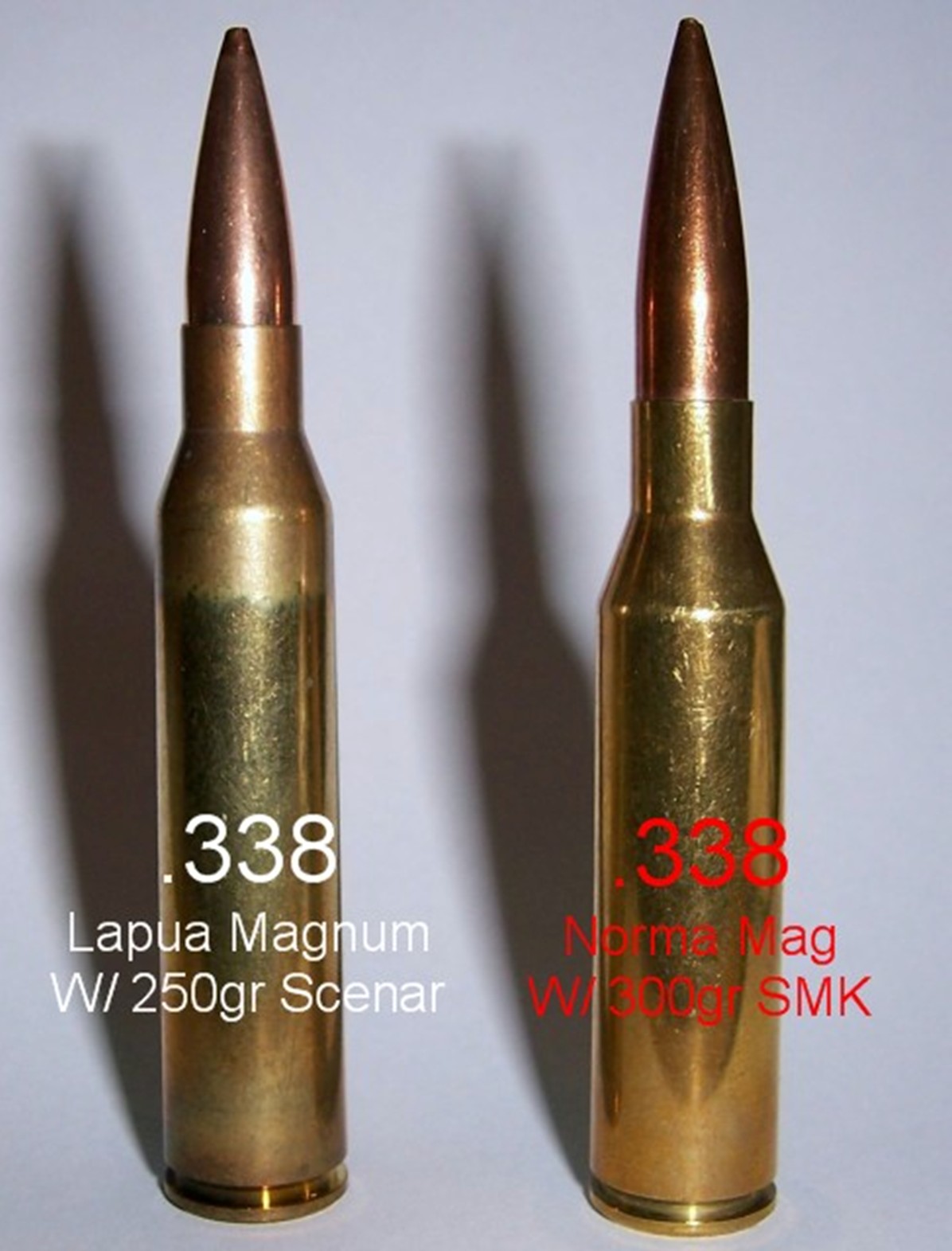
My first thought when I read the Kit Up headline was - why not .338 Lapua? How does the .338 Norma compare to it? I don't know the answer to those questions, but here's this from the article...
The plan was to build the LWMMG in the same round as U.S. Special Operations Command’s new Precision Sniper Rifle, which Remington is now building in .338 Lapua magnum, GD officials said. While the company is pleased with the performance of the shorter .338NM cartridge, it would not be difficult to convert it to .338 Lapua, GD officials maintain.
Sixteen years later, we "greedy" Americans must look more dastardly than ever, right? Wrong.
In 2012, a surprising twist and without ever ratifying it, the United States
became the first major industrialized nation in the world to meet the United
Nation’s original Kyoto Protocol 2012 target for CO2 reductions.
How is this possible? How did we "greedy" Americans succeed in meeting the objectives of the Kyoto Protocol - having never ratified it - while all those virtuous nations that enthusiastically signed the treaty failed?
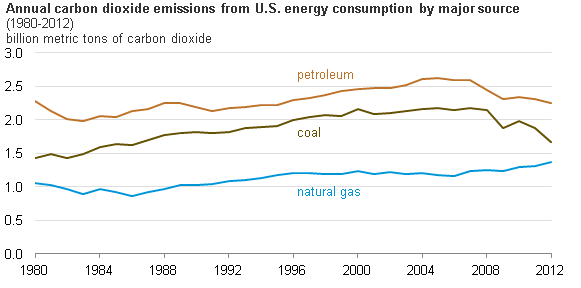
The largest drop in emissions in 2012 came from coal, which is used almost
exclusively for electricity generation (see figure below). During 2012,
particularly in the spring and early
summer, low natural gas prices led to competition between natural gas- and
coal-fired electric power generators. Lower natural gas prices resulted in
reduced levels of coal generation,
and increased natural gas generation—a less carbon-intensive fuel for power
generation, which shifted power generation from the most carbon-intensive fossil
fuel (coal) to the least carbon-intensive fossil fuel (natural gas).
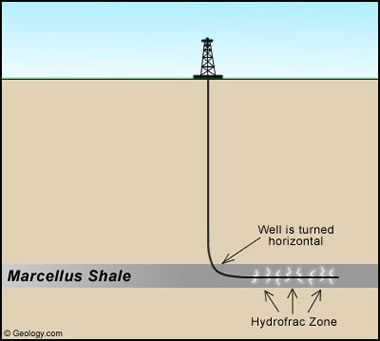
We know that the increased supply of natural gas in the US economy resulted from advances in, and the increased use of, hydraulic fracturing techniques, which unlock reserves that were previously inaccessible. We also know that hydraulic fracturing (fracking) techniques became economically viable because of the recent increase in energy prices. Higher prices created an incentive to invest in fracking. Fracking increased supply, which, along with innovations spurred by competition, resulted in lower natural gas prices, and that prompted energy producers to switch from coal to natural gas.
In other words, free markets succeeded where bloated, collectivist government mandates failed. In other words, American "greed" turned out to be more virtuous than multinational "virtue".
There is another, less rosy possible reason why the US's carbon emissions fell since 2007. The recession began in 2007, and the American economy remains weak. A weak economy results in reduced energy consumption and demand. But I don't think that was a major factor here. After all, Europe's economy is even weaker than that of the US, but all European nations failed to meet their Kyoto goals.
The lesson here is one sensible people learned when they saw the devastation the Soviet Union caused to its environment - free markets work, even in environmental matters.
But don't expect "Environmentalists" to embrace free market solutions to environmental problems. "Environmentalists" are, for the most part, watermelons - green on the outside, red on the inside. Environmental concerns are an excuse for them to give government even greater power over people's lives. No matter how well free market solutions prove to work, most "Environmentalists" will always reject them, because their main concern is not the environment. Their main concern is bloated, morbidly obese, inescapable government.
Ever since the Indian motorcycle company expired in 1953, it's been like a movie franchise that keeps running long after it's gone stale, producing a worse sequel with each iteration. Many have tried to resurrect Indian. All have failed.
In 2011, international motor sport giant, Polaris, acquired Indian. At the time, I considered it a mistake. Polaris already builds the Victory line of cruiser motorcycles, and adding Indian to the mix seemed to me like adding more of the same. I thought (and still think) Polaris needed to diversify and venture into areas of the motorcycle market Victory does not cover.
Although it's a brand new engine, they drew heavily from classic Indian engine
designs. The 49 degree, 111 cubic inch V-Twin has 3 cams, parallel pushrods and
down firing exhausts. The intake is on the left. It's unit construction
providing direct drive between the crankshaft and clutch. The 6 speed overdrive
transmission handles the 115+ foot pounds of torque.
My first impression is that this engine's internals may have been designed by an engineer, but externally it looks designed by an artist. Engineers don't build things this pretty. This looks like an Art Deco sculpture, or something out of a Steam Punk comic book. It's beautiful. I can't wait to see the rest of the bike.
I'm not a fan of cruisers, but the reality is that cruisers dominate the American motorcycle market. Therefore, with few exceptions, manufacturers need strong cruiser lines to perform well in the US, and Polaris seems to be doing very good things with Indian, unlike previous owners.
I'd love it if Polaris proves me wrong. An increase in motorcycle manufacturing in the US is a good thing, no matter what style of motorcycles they manufacture. Besides, if they're successful enough, they'll eventually have to venture out into motorcycle styles I prefer.
That's my hope, anyway. UPDATE:Motorcycle USA has a lot more information, specifications and photos. Here's my favorite.
But Indian Motorcycle wasn’t content to solely treat the crowd to the sight and sound of the new V-Twin. They also debuted a custom-built streamliner named the “Spirit of Munro” built to house the Thunder Stroke 111. Named in honor of Burt Munro’s, “Munro Special,” a 1920 Indian Scout that shattered the under-1000cc land-speed record in 1967, this is not a mere replica. Complete with a custom chassis, exhaust, and intake, it features a chain drive conversion for the tall gearing requisite of a streamliner.
If you haven't watched the movie, The World's Fastest Indian, which dramatizes Munro's Bonneville quest, you're missing out big time.
The “Economic Miracle State” continues to lead the nation with the lowest state unemployment rate at 3% in September, at almost five percentage points below the national average of 7.8%. There were 11 North Dakota counties with jobless rates below 2.0% in September, and Williams County, which is at the epicenter of the Bakken oil boom, continues to boast the lowest county jobless rate in the country at just 0.7%. The exponential growth in North Dakota oil production has fueled exponential growth in the state’s oil and gas jobs, which have more than tripled over the last three years. Overall employment throughout the entire state increased 5.6% over the twelve month period through September; four times the tepid 1.4% pace of job growth nationally during that period.
It ain't no miracle. It's a deliberate decision to allow free market forces to work and create wealth by accessing the state's natural raw materials, namely petroleum.
What’s especially impressive is the incredible exponential increase in North Dakota’s oil production over such a short period of time. The state’s oil production has doubled in just the last 16 months, from 364,160 bpd in May of last year to 728,494 in September of this year. Oil coming out of the state’s Bakken Formation is behind the huge increase, as that oil field in western North Dakota now supplies 91% of the state’s oil, up from only 78% of the state’s oil two years ago. Bakken oil output has doubled in just the last 15 months, from 320,435 bpd last June to 662,428 bpd in September (see bottom chart above). At the current pace of production increases, North Dakota’s oil production will surpass one million bpd by the end of next year. And it’s the exponential increases in shale oil production in the Bakken region of North Dakota and the Eagle Ford Shale region of Texas that have the United States on a trajectory to become the world’s largest oil producer in the next eight years.
Considering North Dakota's economic boom due to "frackin' the Bakken", and that the US has more petroleum in the Green River Formation than all the world's known oil reserves, the federal government must be eager to allow more drilling and exploration on federal lands, right?
The Interior Department on Friday issued a final plan to close 1.6 million acres of federal land in the West originally slated for oil shale development.
The proposed plan would fence off a majority of the initial blueprint laid out in the final days of the George W. Bush administration. It faces a 30-day protest period and a 60-day process to ensure it is consistent with local and state policies. After that, the department would render a decision for implementation.
The US is over $16,000,000,000,000 in debt and counting. The federal government added over $120,000,000,000 to that debt in October 2012 alone and is on track to add another $1,320,000,000,000 to the debt by the end of fiscal year 2013. Raising taxes will likely cause the economy to slow even more. Even if the federal government were to cut spending drastically (good luck with that), we would need enormous economic growth to begin paying down our monstrous debt.
In other words, we need the kind of growth North Dakotans have enjoyed for years.
UPDATE (19NOV2012): The following charts demonstrate how hydraulic fracturing (fracking) has increased total US reserves of petroleum and natural gas by making previously unavailable reserves available. Further technological advances will make the Green River Formation available.
Have you ever walked into a doctor's office and seen a list of prices for the services they offer? No? Have you ever asked why not? Every establishment that sells a good or service provides an up-front list of prices, or at least an estimate. The one exception is health care providers. The reason is insurance.
When you buy something for yourself with your own money, you naturally look for the highest quality at the best price. That desire, and competition between providers, drives costs down and quality up.
When you buy something for yourself with someone else's money, you naturally look for the best quality, but not necessarily the best price.
That's what happens with health insurance, and why health care prices keep increasing.
The "solution" you'll typically hear for this problem is to make health care 100% government-run. But that makes the problem worse, because it introduces another layer of separation between the customer and the price. When you buy something for someone you don't know or care about with other people's money, you neither care about the price nor the quality.
Furthermore, that solution fails to take into account the fact that government caused the problem in the first place by placing price controls on the amount companies could pay employees back in 1942. Companies then began compensating workers with health insurance packages, and the modern health care behemoth was born. Believing that greater government intervention will cure a problem government intervention caused is like believing that a poisoned patient should drink more poison to save himself.
The Surgery Center demonstrates that it’s possible to offer high quality care at low prices. "It's always been interesting to me,” says Dr. Jason Sigmon, “that in any other industry, tons of attention is devoted to making systems more efficient, but in health care that's just completely lost."
The bill, which is strictly for the hospital itself and doesn't include Sigmon's or the anesthesiologist's fees, totaled $33,505. When Sigmon performs the same procedure at the Surgery Center, the all-inclusive price is $5,885.
How can the Surgery Center offer the same procedure at 1/6 the cost of the hospital?
Three years ago, Dr. Keith Smith, co-founder and managing partner of the Surgery Center of Oklahoma, took an initiative that would only be considered radical in the health care industry: He posted online a list of prices for 112 common surgical procedures. The 51-year-old Smith, a self-described libertarian, and his business partner, Dr. Steve Lantier, founded the Surgery Center 15 years ago, after they became disillusioned with the way patients were treated at St. Anthony Hospital in Oklahoma City, where the two men worked as anesthesiologists.
Transparent, direct, package pricing means the patient knows exactly what the cost of the service will be upfront. Fees for the surgeon, anesthesiologist and facility are all included in one low price. There are no hidden costs, charges or surprises.
"In every other field of medicine, the price is going up faster than consumer prices in general," said Dr. John Goodman, president of the National Center for Policy Analysis.
"[But] the price of Lasik surgery, on average, has gone down by 30 percent." [this article is from 2006, whereas the chart to the right is from 2009 ~ OS]
Prices dropped even though doctors pay for advertising. And while the procedure got cheaper, it also got better.
"When the lasers first came out, all they could treat was nearsightedness," Bonanni said. "[Today] the lasers are faster, more precise."
The same is true of most cosmetic surgery procedures.
So, the answer to ever-increasing health care costs is not more government intrusion, but less. The answer, as usual, is the free market.
FEMA has largely screwed up the response to Super Storm Sandy, just as they did with Katrina. But that shouldn't come as a surprise. Central planning by a distant federal government agency rarely works as well as local planning. Think about it. Who knows your neighborhood better; you, or some DC bureaucrat?
"There's no leadership here, nobody knows what's going on," said Christopher Janusis, a Staten Island resident, whose house and neighborhood were badly hit by Sandy.
For Janusis and thousands of other Staten Islanders whose lives were so suddenly changed by Sandy, there are many reasons to complain. But rather than do that, and rather than wait for government help, the residents took matters into their own hands: They organized a volunteer-driven relief effort that could be an example for FEMA and other aid agencies might do well to study.
As ordinary people often do, they innovated in the face of crisis.
Cangiano and her fellow volunteers showed they could rip through the red tape that often stifles aid organizations, and focus on the calls for help.
"We were monitoring Facebook and other social media," she said. "As calls and messages came in for help, we responded by sending cars full of food and supplies to the areas that needed it most."
I doing so, they demonstrated what neighbors voluntarily helping each other can accomplish.
Cosentino tells Fox News that the main thing to be learned is "that the people themselves on Staten Island saved most of the lives here and are doing most of the work, along with volunteers from other areas." He says "you have incredibly valuable resources here that need be pooled to get the job done."
...small businesses, neighbors and local leaders teamed up to ensure people had clothes, food, water, blankets and hot meals, as well as other survival basics.
Democrats accuse those who believe in small, limited government of saying to everyone, "you're on your own". The obvious implication is that only government can organize people (by force) to accomplish anything good and decent, which is an obvious load of crap. Left to their own devices, decent, free people naturally band together to help each other. That is the direct opposite of selfishness, and fosters community and friendship among neighbors.
Yes, the federal government can play a role in disaster relief, but that should be the last resort, when it's clear that volunteers, local government, state government, and neighboring states are overwhelmed by the size of the disaster.
Always remember that, regardless of the competence of government's response, you are your own first line of defense, then your immediate family, then you neighbors. See my post on disaster prep for great ideas from Popular Mechanics on how to make those lines of defence as effective as possible.
Despite all the Malthusian doom prophesies, human beings keep disproving (disappointing?) the prophets and innovating new ways to adapt to their changing circumstances. The latest and most popular Cassandras (with apologies to Cassandra of Troy, whose prophesies were true) are "environmentalists", and among their many dooms day predictions is "Peak Oil". The idea is that if we continue to rely on petroleum and other fossil fuels, we'll soon exhaust those raw materials and end up in a real life version of Mad Max.
Drillers in Utah and Colorado are poking into a massive shale deposit trying to find a way to unlock oil reserves that are so vast they would swamp OPEC.
A recent report by the U.S. Government Accountability Office estimated that if half of the oil bound up in the rock of the Green River Formation could be recovered it would be "equal to the entire world's proven oil reserves."
Both the GAO and private industry estimate the amount of oil recoverable to be 3 trillion barrels. "In the past 100 years — in all of human history -- we have consumed 1 trillion barrels of oil. There are several times that much here," said Roger Day, vice president for operations for American Shale Oil (AMSO).
Why haven't we tapped into this incredible resource? Cost.
Exploration well 40 miles northwest of Rifle, CO
This tantalizing bonanza, however, remains just out of reach, at least for now. The cost of extracting the Green River oil at the moment would be higher than what it could be sold for.
The reason for the cost is a technical problem.
The hydrocarbons in Green River shale are more intimately bound up with the rock, so that fracking cannot release them. The shale has to be heated to 5,000 degrees Farenheit before it will give up its oil.
Producers have been trying to accomplish that in one of two ways: Either they bring the shale to the surface and then cook it , or they sink a deep shaft and place an electric heater at the base, a process called in-situ. AMSO has been testing in-situ with mixed success.
And that's why Thomas Robert Malthus and his philosophycal descendants constantly prove to be wrong. They underestimate human ingenuity and the effects of economics (which is ironic, since Malthus was an economist). High prices provide an incentive for people to devise solutions to a problem. That's what engineers do. They apply scientific principles to solving practical problems. Once the problems is solved, engineers refine the methods used to solve the problem, and the solution becomes less expensive.
What drives all this problem solving? The profit motive.
And that explains why "environmentalists" constantly underestimate this process.
"Environmentalists" are almost universaly Socialist. They don't understand the profit motive, or how it makes people's lives better. If they did, they'd be Capitalists.
Federalism is part of the genius of the Constitution, which gives the federal government very clear, limited powers, and leaves all other "rights and powers" in the hands of "the people and the various states". All states face similar problems; crime, unemployment, natural disasters, etc. But each state devises different solutions to those problems. Some work better than others. Some are worse than the problems they're supposed to fix.
When one states' solution works well, other states follow suit, although usually with local variations. When a solution fails miserably, the smart states learn from their neighbors' mistakes and stay away. States are also more responsive to their residents than is the federal government, mostly because they have fewer people to please.
Finally, if a person is unhappy with his/her state, at worst they can move to a state they think does things better, which is a whole lot easier than moving to another country. Trust me. I've done both.
And that is what makes Federalism work; competition between states.
One area in which states compete is the job market. Some states make it easier than others for businesses to create jobs, which means more businesses move to those states, which means more people move to those states looking for work. Which states make it easiest for businesses to create jobs?
40% of the US population created 75% of new jobs.
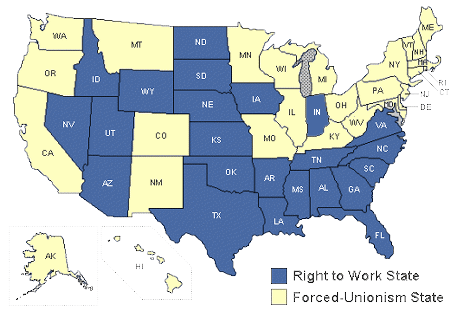
Since the recession ended in June 2009, almost three out of every four jobs added to U.S. payrolls have been in Right to Work states (1.86 million out of 2.59 million), even though those 22 states represent only 38.8% of the U.S. population (120 million). In contrast, only about one of every four new jobs were created in forced-unionism states (730,000), even though more than 61% of Americans live in those 28 states (189 million). Relative to their population, the Right to Work states have been job-creating powerhouses during the recovery, and forced union states haven’t even come close to “carrying their weight” in terms of their share of the population. Adjusting for differences in population, Right to Work states created four new jobs for every one job added in forced union states, because those 21 RTW states created 2.54 times more jobs even though forced union states have 1.6 times as many people.
That means that, since June 2009, 40% of the population created about 75% of the new jobs in the US. So, which are these right-to-work, job-creating power houses?
States with right-to-work laws, and forced union membership laws.
So, is there a correlation between a business-friendly climate and job growth? If so, which party's policies lead to the most job growth? Judge for yourself.
Here are the top 20 most-friendly business states according to CNBC:
So, naturally, American voters elected a president with a similar pro-growth, pro-jobs agenda, right? Not really.
President Obama, speaking at an AFL-CIO conference in April this year, “I believe when folks try to take collective bargaining rights away by passing so-called right-to-work laws, which might also be called ‘right-to-work for less’ laws, that’s not about economics, that’s about politics.”
Is it any wonder the US economy has been stagnant since 2009? Pres Obama should thank all those Republican governors and legislators, because without them, he'd have no "jobs created or saved" to brag about.
Ronald Reagan said that "the best social program is a job". He was absolutely right. Government welfare programs don't lift people out of poverty. Jobs do. Businesses create jobs. Demonizing businesses and weighing the down with excessive regulation and taxation doesn't work.
Recent remarks by President Obama to a Denver-based TV anchor stand in stark contrast to new emails obtained by CompleteColorado.com.
This past Friday, President Obamatold KUSA's Kyle Clark, in response to a question on the federally-backed but failed Colorado company Abound Solar, "And these are decisions, by the way, that are made by the Department of Energy (DOE), they have nothing to do with politics."
Of course they have nothing to do with politics. Specifically, they have nothing to do with the fact that...
Abound Solar... counts major Obama bundler Pat Stryker among its early backers
But never mind that. Let's go to the emails. Here's the key sentence.
You better let him know the WH wants to move Abound forward.
What? I thought that "these... decisions... are made by the Department of Energy", not the White House! Say it ain't so!
Next time a politician rails against those eeeeeevil venture capitalists, then touts the need for government to "invest" some corporation or industry, keep three things in mind.
Venture capitalists use their own money, or investors' money, to invest in companies they believe will turn a profit. Either way, the investors provide the money voluntarily.
Governments that "invest" in companies force tax payers to give their money to those companies, whether the tax payers think it's a good investment or not.
Politicians always make decisions based on political considerations.
Politicians don't pick winners and losers. They pick losers. Because the winners don't need government to force people to give them money.
1. The percentage of low-income households with a computer rose to 47.7% in 2009 from 19.8% in 2001.
2. Appliances? The percentage of low-income homes with air-conditioning equipment rose to 83.5% from 65.8%, with dishwashers to 30.8% from 17.6%, with a washing machine to 62.4% from 57.2%, and with a clothes dryer to 56.5% from 44.9%.
3. The percentage of low-income households with microwave ovens grew to 92.4% from 74.9% between 2001 and 2009. Fully 75.5% of low-income Americans now have a cell phone, and over a quarter of those have access to the Internet through their phones.
Clearly, the average percentage of their income that people spend on necessities has decreased steadily over the last 50 years. Why does this matter? Because people who spend less on necessities have more left over to spend on things they actually want.
What makes this possible? Free markets do. Free markets force manufacturers to innovate or die, thereby making their products more affordable.
Does it matter that an increasing percentages of Americans can afford refrigerators, microwave ovens, dish washers, clothes washers and dryers?
Of course it does. If you don't believe me, try living without them.
On Tuesday, a new company called Planetary Resources Inc. will unveil its plans to mine asteroids that zip close by Earth, both to provide supplies for future interplanetary travelers and to bring back precious metals like platinum. ......
He was quick to add that the company’s business premise was not as impractical as it might sound. Because an asteroid is devoid of air and its gravitational pull is negligible, getting there is relatively easy. Unlike landing on the moon or Mars, a robotic mining spacecraft would not need parachutes or a large engine to fly up to and attach itself to a small asteroid. ......
“There are probably about 1,500 near-Earth asteroids that are energetically easier to reach than the surface of the moon,” Mr. Anderson said. ......
Platinum — which is used for jewelry, electronics components and automobile catalytic converters — fetches about $1,500 an ounce these days, so a single spacecraft would not have to bring back a lot of it for the enterprise to make money. More common metals like iron could perhaps be used as raw materials in space factories, churning out spacecraft and other structures.
I've thought for years that mining asteroids sounded like a good idea. Many asteroids are full of metals that are extremely industrially useful, but relatively rare on the Earth's surface. Because of those two factors, they're also expensive. Even so, I've doubted that mining asteroids could be economically viable. Hopefully I'm wrong about that.
As I wrote earlier, the private space race is now in full swing. This shouldn't surprise anyone. The people who explored the ends of the Earth did so mostly in search of profit, not as part of some giant government bureaucracy. It stands to reason that space exploration should be the same.
Not just any airplane - the biggest airplane in history. And not just any spacecraft - the new rocket from Space Exploration Technologies, a private corporation developing everything from orbital vehicles for NASA to commercial passenger vehicles.
The record-breaking plane, which will have six engines and twin fuselages, is being built to carry a rocket to 30,000 feet. From there, the rocket will drop from the plane and blast into space. The first payloads will consist of satellites and other cargo, but the program's backers say the rocket will eventually carry passengers. The Roc will be a flying launchpad—government and private-sector customers welcome.
If the concept of behind Space X's new launch vehicle seems familiar, that's probably because it's very similar to - even if far larger than - Scaled Composites' Space Ship One and its launcher, White Knight. In fact, Burt Rutan, founder of Scaled, is on the board of Space X.
In a related note, the era of government-monopolized space travel is over. The private, for-profit space race is now in full swing, and Reason TV is glad, as am I.
Recently, I wrote about the Obama Administration's wasteful "investing" of billions of dollars into unproductive "green" business ventures. To be clear, I oppose all government subsidies for private businesses. Government inherently "invests" in failure, because when a business is successful, there's no need for government to prop it up with tax money. A successful business's profits keep it afloat just fine. That begs the question; why would we want government to prop up a failing business? Answer; we don't. So why do we citizens continue to allow it?
One of those businesses is Fisker, makers of the Karma, a luxury electric car with a range-extending, four cylinder, turbocharged generator made by another failed business in which the Obama Administration invested; GM. Consumer Reports bought a Karma for $108,000 for testing and immediately had serious trouble with it. After a trip to the dealership, CR finally got their car back, completed their road test report and found that many other customers are having similar issues. Video and some text follow.
Normally when we have a car like this at our test facility, it has no problem accumulating break-in miles. After all, big luxury sedans lend themselves to road trips. But the Fisker is languishing in our lot, going out mostly for short commutes that remain well within cell-phone coverage in case of trouble--a concern in the rural area surrounding our track. Just this weekend, for example, the speedometer and energy meter display disappeared when driving, on top of having several other rogue warning indicators appear last week. It is expected we'll be revisiting the dealership soon. We've had cars in the past that have been troublesome, but never anything like this.
Reading comments on our recent blogs, posts to owner forums, and searching the National Highway Traffic Safety Administration (NHTSA) complaints database, we have found several notable issues reported. While there are not a high number of complaints, it does show we are not alone. And remember, there have been only about 500 cars sold, according to Fisker, and the owners skew to the affluent, meaning the Karma is not the typical owner's only car and miles have likely been modest thus far. Examples of complaints include:
My Karma (with less than a thousand miles on it) had a mysteriously worn-down coupling between one of the motors and the wheels. This will require a completely new differential. As of today... my Karma [has been] "in the shop" longer than I have driven the car. And the prospect of having it in the shop for another 2 weeks (or possibly longer) is making me really unhappy...
Great. So the Obama Administration spent half a billion of your dollars and mine to subsidize a lemon for exceptionally wealthy people who want to be absolved of their sins against Gaia.
Again, if Pres Obama and his worshipers want to waste their own money on a venture like this, that's their problem. But I don't have a lot of disposable income to flush down the "green" toilet. Do you?
Yesterday, I pointed out how Pres Obama lies about the amount of petroleum we have right here in the US. Investors Business Daily had already pointed out that fact earlier this week.
When he was running for the Oval Office four years ago amid $4-a-gallon gasoline prices, then-Sen. Barack Obama dismissed the idea of expanded oil production as a way to relieve the pain at the pump.
"Even if you opened up every square inch of our land and our coasts to drilling," he said. "America still has only 3% of the world's oil reserves." Which meant, he said, that the U.S. couldn't affect global oil prices.
It's the same rhetoric President Obama is using now, as gas prices hit $4 again, except now he puts the figure at 2%.
"With only 2% of the world's oil reserves, we can't just drill our way to lower gas prices," he said. "Not when we consume 20% of the world's oil."
But the figure Obama uses — proved oil reserves — vastly undercounts how much oil the U.S. actually contains. In fact, far from being oil-poor, the country is awash in vast quantities — enough to meet all the country's oil needs for hundreds of years.
The U.S. has 22.3 billion barrels of proved reserves, a little less than 2% of the entire world's proved reserves, according to the Energy Information Administration. But as the EIA explains, proved reserves "are a small subset of recoverable resources," because they only count oil that companies are currently drilling for in existing fields. When you look at the whole picture, it turns out that there are vast supplies of oil in the U.S., according to various government reports.
Contrary to Pres Obama's dire estimate, various federal agencies, (including the US Geological Survey, as I pointed out yesterday), the US contains over 1.5 trillion barrels of recoverable petroleum.
Again, these are Federal Government reports. Is Pres Obama not a member of the Federal Government? Are these reports unavailable to Pres Obama, but available to me and IBD? Is Pres Obama incapable of reading them?
So, Obamaphiles, is your messiah lying to you, or is he ignorant? Because those are the only two possible reasons he keeps repeating the 2% myth. So, which is it?
The Marine Corps and Army have tapped Ceradyne Inc., to make the first of the new Enhanced Combat Helmets, ending a five-year search for a brain bucket capable of stopping rifle rounds.
The Marines and Army have given the green light to Ceradyne to build 8,600 ECHs, which will be split between the services. Fielding won’t begin until after the services approve the ECH for full-rate production, a decision scheduled for May, according to a recent press release.
SPC Tom Albers survived a rifle round to the helmet with no injuries in Afghanistan.
Our current helmets are already very good. A very short search turned up several stories of US Soldiers and Marines, and a UK Soldier who survived rifle rounds to the helmet; none of which penetrated the shell.
I did find one story of a UK Soldier who survived a rifle round to the helmet even though it penetrated. That being said, British and Australian helmets are different than ours. I don't know which is better.
German sniper team.
Armor - whether on battle ships, tanks or individual Soldiers - is always a compromise between protection and mobility. Given the same technology, more protection = more weight = less mobility. That's why Special Ops servicemen, who generally require more mobility than ordinary Soldiers, often use helmets like the ones to the below. Note the large cutouts over the ears that make the helmets lighter and block less sound, but also provide less protection.
The new helmets the US Army and Marine Corps commissioned supposedly use new technology that provides more protection without adding weight. I think I'd be happy with the same protection our current helmets provide with less weight.
Back in 2008, when Hope'n'Change (TM) was all the rage, then-Senator Obama was a little more honest about his energy policies.
Monterey Park, CA (LA Times)
USA Today reports that gas prices average $3.83/gal for regular gasoline nationwide, but for about 1/3 of Americans, they've already crested $4.00/gal. Fortunately for us, Kansas - a petroleum producing state - has lower gasoline prices than the majority of the country. The last time I bought Diesel it cost us $3.96/gal.
What does Pres Obama say now about how his energy policies affect prices?
Essentially, "It's not my fault. I'm doing everything I can to keep gas prices low for you". Pretty different tune, right?
By the way, Pres Obama's oft-repeated trope that "we only have 2% of the world's proven oil reserves" is a lie. Either that, or he's ignorant of the facts. Take your pick. According to a report published in 2008 by the US Geological Survey, the Bakken Formation of North Dakota and Montana contains "3.0 to 4.3 billion barrels of undiscovered, technically recoverable oil...a 25-fold increase in the amount of oil that can be recovered compared to the agency's 1995 estimate of 151 million barrels of oil." The RAND Corporation published another study in 2008 stating that:
The largest known oil shale deposits in the world are in the Green River Formation, which covers portions of Colorado, Utah, and Wyoming. Estimates of the oil
resource in place within the Green River Formation range from 1.5 to 1.8 trillion
barrels. Not all resources in place are recoverable. For potentially recoverable oil shale
resources, we roughly derive an upper bound of 1.1 trillion barrels of oil and a lower
bound of about 500 billion barrels. For policy planning purposes, it is enough to
know that any amount in this range is very high. For example, the midpoint in our
estimate range, 800 billion barrels, is more than triple the proven oil reserves of Saudi
Arabia. Present U.S. demand for petroleum products is about 20 million barrels per
day. If oil shale could be used to meet a quarter of that demand, 800 billion barrels
of recoverable resources would last for more than 400 years.
So, why is Pres Obama still repeating this lie? Simple. The tiny percentage of our available petroleum and gas reserves to which he allows access only amounts to 2% of the world's known reserves. So, when Pres Obama brags about increasing oil production in the US, keep in mind that he and his fellow Democrats continue to prevent far greater exploration.
What about all the "investments" Pres Obama brags about in his weekly address? Does the word "Solyndra" mean anything to you?
Take, for instance, Beacon Power Corp., the second recipient of an Energy Department loan guarantee in 2009. In March 2010, the Massachusetts energy storage company paid cash bonuses of $259,285 to three executives in part due to progress made on the $43 million energy loan, Securities and Exchange Commission records show. Last October, Beacon Power filed for Chapter 11 bankruptcy.
EnerDel, maker of lithium-ion battery systems, landed a $118.5 million energy grant in August 2009. About one-and-a-half years later, Vice President Joe Biden toured a company plant in Indiana and heralded its taxpayer-supported expansion as one of the "100 Recovery Act Projects That Are Changing America."
Two months after Biden's visit, EnerDel corporate parent Ener1 paid $725,000 in bonuses to three executives -- including $450,000 to then-CEO Charles Gassenheimer, who led Biden on the tour. This January, Ener1 filed for Chapter 11 bankruptcy protection.
In fact, the Government Accounting Office reported that 85% of the Department of Energy's "investments"granted and committed under their "Loan Guarantee Program — $30 billion in all — shows systemic mismanagement, uncompleted reviews, missing documentation, and a process failure rate of 85% or more".
What about all those wonderful electric cars Pres Obama touts constantly?
Fisker Automotive, the electric car company that received $528 million in Energy Department loan guarantees, announced layoffs at its Delaware production facility on Monday.
... "We have temporarily delayed work at the plant based on ongoing discussions with the DOE regarding funding for the Project Nina program. As a result, we have laid off 26 people," the company said in a statement Monday.
I love Fisker's quote in the video. "We're not in the business of failing, we're in the business of winning, that's why we make the right choices for the company, that's why we went to Finland." That's great, Mr Fisker. I fully support you doing what makes your company most profitable... with your own damn money!
And note how EnerDel and the Fisker plant in the US went to Delaware - VP Biden's home state. It's almost as though all this "investing in green technology" is nothing more than crony capitalism. Say it ain't so, Joe!
Check out what happened when Consumer Reports bought a Fisker Karma to test.
The credit’s enhanced value would bring the purchase price of alternative-energy vehicles more in line with conventional models, supporters say. Partly because of the vehicles’ costs, sales have been a problem. General Motors announced last week that it was suspending production for five weeks of the Chevrolet Volt, a plug-in hybrid that Mr. Obama has promoted in the past.
So, supporters admit that, right now, the benefits of alternative-energy vehicles don’t yet outweigh the costs to consumers. To the producers of such vehicles, I say: Tough luck. The onus is on them to produce a product that consumers actually want to purchase at a price they can afford. Tax credits might give consumers more reason to purchase the vehicles, but it won’t give the producer any incentive to look for cheaper ways to manufacture them. The president’s tax credit ensures that taxpayers will continue to pay an arbitrarily high price for the vehicles long after the market would have brought costs down.
That's the story with all of Pres Obama's "green tech investments"; risking your money and mine on long shot gambles. Did you authorize those gambles? I didn't.
Worst of all, these "investments" amount to subsidizing the wealthy. The Fisker Karma and Tesla Roadster both cost over $100,000. Can you afford a $100,000 car? I can't. The average Chevy Volt owner's income is $170,000. Do you make $170,000/year? I don't. Yet you and I are paying $10,000/car so that someone who makes $170,000/year will buy one.
Does that make sense to you?
I oppose all subsidies for private industry. Private companies should stand on their own profitability or not at all. That includes energy companies. We need energy to do absolutely everything we do in our economy - buy, sell, ship, store and/or provide goods and services. So if our energy sources are not economically viable, our entire economy can't be economically viable. Ed Morrissey Puts it well:
I like Ace’s approach to technological development:
I prefer the “Old” approach to emerging technology: We adopt new technology when it is better and cheaper than the old technology, not when it is worse and more expensive, forced to convert over by a government demanding we pay more for less. So we can reap all these speculative benefits in a hypothetical future.
You know what I liked best about the old approach, other than the fact that it worked; It didn’t require government to place bad bets on companies like Solyndra that wouldn’t have survived otherwise to ruin more capital and resources.
Think about that for a moment: these government interventions cost us money whether we get more energy efficient or not. And what has it produced? Nothing of consequence, and nothing that would last once the subsidies that make them artificially competitive now (to the extent they’ve even achieved that status) once the subsidies end.
The old method of allowing capital to produce innovation and consumers to choose winners brought us prosperity and technological advancement. Obama’s has brought us bankruptcies, soaring debt, and no progress at all. That’s change, all right.
 First, the fracking revolution could have just as easily taken place in Russia, China, or a number of other places, but instead it happened in the US. One reason for that is stronger property rights in the US than in other countries. Most fracking in the US takes place om privately owned land. In most states, the land owner also owns the mineral rights for his/her land. That means they can make more money from allowing a fracking firm to drill on their land, which gives the land owner more incentive to do so.