Saturday, November 17, 2012

Taking Matters Into Their Own Hands

FEMA has largely screwed up the response to Super Storm Sandy, just as they did with Katrina.  But that shouldn't come as a surprise.  Central planning by a distant federal government agency rarely works as well as local planning.  Think about it.  Who knows your neighborhood better; you, or some DC bureaucrat?

Granted, NYC screwed things up pretty badly as well, and Mayor Bloomberg deserves far more of the blame than FEMA, but just as Katrina did in 2004, Sandy demonstrates that local people organizing themselves voluntarily can accomplish far more than top-down, impersonal government bureaucracies.
"There's no leadership here, nobody knows what's going on," said Christopher Janusis, a Staten Island resident, whose house and neighborhood were badly hit by Sandy.

For Janusis and thousands of other Staten Islanders whose lives were so suddenly changed by Sandy, there are many reasons to complain. But rather than do that, and rather than wait for government help, the residents took matters into their own hands: They organized a volunteer-driven relief effort that could be an example for FEMA and other aid agencies might do well to study.
As ordinary people often do, they innovated in the face of crisis.
Cangiano and her fellow volunteers showed they could rip through the red tape that often stifles aid organizations, and focus on the calls for help.

"We were monitoring Facebook and other social media," she said. "As calls and messages came in for help, we responded by sending cars full of food and supplies to the areas that needed it most."
I doing so, they demonstrated what neighbors voluntarily helping each other can accomplish.
Cosentino  tells Fox News that the main thing to be learned is "that the people themselves on Staten Island saved most of the lives here and are doing most of the work, along with volunteers from other areas." He says "you have incredibly valuable resources here that need be pooled to get the job done."

...small businesses, neighbors and local leaders teamed up to ensure people had clothes, food, water, blankets and hot meals, as well as other survival basics.
Democrats accuse those who believe in small, limited government of saying to everyone, "you're on your own".  The obvious implication is that only government can organize people (by force) to accomplish anything good and decent, which is an obvious load of crap.  Left to their own devices, decent, free people naturally band together to help each other.  That is the direct opposite of selfishness, and fosters community and friendship among neighbors.

Yes, the federal government can play a role in disaster relief, but that should be the last resort, when it's clear that volunteers, local government, state government, and neighboring states are overwhelmed by the size of the disaster.

Always remember that, regardless of the competence of government's response, you are your own first line of defense, then your immediate family, then you neighbors.  See my post on disaster prep for great ideas from Popular Mechanics on how to make those lines of defence as effective as possible.

Friday, November 16, 2012

Euro Zone Back in Recession (Updated)

How's Socialism working for Europe?
The debt crisis dragged the euro zone into its second recession since 2009 in the third quarter despite  modest growth in Germany andFrance, data showed on Thursday.
The two leading economies both managed 0.2 percent growth in the July-to-September period.
Got that?  Their two leading economies grew at the roaring rate of 0.2%.
But the resilience could not save the austerity-hit 17-nation bloc from overall contraction as the likes of The Netherlands, Spain, Italy and Austria shrank.

Economic output in the euro zone fell 0.1 percent in the quarter, following a 0.2-percent drop in the second quarter.

Those two quarters of contraction put the euro zone’s 9.4 trillion euro ($12 trillion) economy in recession, although Italy and Spain have been contracting for a year already and Greece is suffering an outright depression.
Incredibly, this is the direction some Americans actually want to follow them off the cliff by spending more, borrowing more and taxing more.  It's insane.  We should be taking the opposite approach, because as Ed Morrissey states...
At some point, the Germans and French citizens will tire of having their production dedicated to rescuing less disciplined neighbors on the Continent.  When that day comes, the Atlantic will not protect us from the shock waves — which is why it’s more urgent than ever for the US to get its own fiscal house in order.
Fortunately, our president promised to cut the deficit in half by the end of his first term.  Of course, it's his second term now, and he hasn't even tried, but it's the thought that counts, right?

UPDATE (18NOV2012): Half of UK voters want to leave the EU, and I can't say that I blame them.
The survey will fuel the growing political debate about Britain’s future place in the EU, which has seen even Cabinet ministers suggesting that the UK would prosper outside the union.

The YouGov poll showed that 49 per cent of voters would vote to leave the EU in a referendum. Twenty-eight per percent said they would opt to remain a member, while 17 per cent said they did not know how they would vote.

British voters are also gloomy about the future of the EU: 65 per cent said they are pessimistic about the union’s prospects, while only 22 per cent were optimistic.
Another poll published yesterday in The Guardian claims it's more like 56%, but the link wouldn't work for me (maybe it'll work now).

Remember when Americans thought the EU would overtake the US as the world's leading economic power?  No nation, or group of nations, can spend more than they take in, lavish their population with welfare programs that give them incentives to not work, punish those who do work with excessive taxes, make it excessively difficult to start or run a business with excessive regulation,  produce too few children to replace in the future the people who are working today, and expect to survive.

And we're making all the same mistakes.

Exercise Myths

Do you think the woman in the picture below is hurting the baby in her womb by lifting her toddler overhead?

Few would answer that question, "yes".  The answers would most likely range from "no", to "probably not" to "if she was strong enough to lift the child before she got pregnant, she's mostly likely strong enough to do so while pregnant".

So then, why do so many people freak out when they see the same woman lifting a 35 lb kettlebell overhead, which weighs roughly the same as the toddler, and is far less awkward to lift?

Pregnant women have been lifting their toddlers - and even older children - ever since there have been pregnant women and toddlers.  If pregnant women really were so frail that they couldn't lift that weight safely, there would be a lot fewer of us today.  For some reason, however, Westerners in the last 50 - 60 years began to see pregnancy almost as a disability, and the resulting lack of physical activity among pregnant women, coupled with a modern Western diet full of refined grains, starches, sugars, hydrogenated fats and other processed foods, results in illnesses like gestational diabetes and obesity, which are far more harmful to the woman and child than lifting a weight no heavier than a toddler. 

Thursday, November 15, 2012

So Much For Peak Oil

Back when Mel Gibson was cool
Despite all the Malthusian doom prophesies, human beings keep disproving (disappointing?) the prophets and innovating new ways to adapt to their changing circumstances.  The latest and most popular Cassandras (with apologies to Cassandra of Troy, whose prophesies were true) are "environmentalists", and among their many dooms day predictions is "Peak Oil".  The idea is that if we continue to rely on petroleum and other fossil fuels, we'll soon exhaust those raw materials and end up in a real life version of Mad Max.

Unfortunately for Gaia's worshipers, but fortunately for us, there's more ptroleum in Colorado alone, than we've ever used.
Drillers in Utah and Colorado are poking into a massive shale deposit trying to find a way to unlock oil reserves that are so vast they would swamp OPEC.

A recent report by the U.S. Government Accountability Office estimated that if half of the oil bound up in the rock of the Green River Formation could be recovered it would be "equal to the entire world's proven oil reserves."

Both the GAO and private industry estimate the amount of oil recoverable to be 3 trillion barrels.
"In the past 100 years — in all of human history -- we have consumed 1 trillion barrels of oil. There are several times that much here," said Roger Day, vice president for operations for American Shale Oil (AMSO).
Why haven't we tapped into this incredible resource?  Cost.
Exploration well 40 miles northwest of Rifle, CO
This tantalizing bonanza, however, remains just out of reach, at least for now. The cost of extracting the Green River oil at the moment would be higher than what it could be sold for.
The reason for the cost is a technical problem.
The hydrocarbons in Green River shale are more intimately bound up with the rock, so that fracking cannot release them. The shale has to be heated to 5,000 degrees Farenheit before it will give up its oil.

Producers have been trying to accomplish that in one of two ways: Either they bring the shale to the surface and then cook it , or they sink a deep shaft and place an electric heater at the base, a process called in-situ. AMSO has been testing in-situ with mixed success.
And that's why Thomas Robert Malthus and his philosophycal descendants constantly prove to be wrong.  They underestimate human ingenuity and the effects of economics (which is ironic, since Malthus was an economist).  High prices provide an incentive for people to devise solutions to a problem.  That's what engineers do.  They apply scientific principles to solving practical problems.  Once the problems is solved, engineers refine the methods used to solve the problem, and the solution becomes less expensive.

What drives all this problem solving?  The profit motive.

And that explains why "environmentalists" constantly underestimate this process. 

"Environmentalists" are almost universaly Socialist.  They don't understand the profit motive, or how it makes people's lives better.  If they did, they'd be Capitalists.

Ausies Set New Sniper Record

Who'll get to 3,000 m first?
Barrett M82A1 50 caliber rifle
Earlier this year a Commando sniper team was secreted in Helmand. Through binoculars at a distance invisible to the naked eye they spotted a group of Taliban. The soldiers having means of identifying targets went through a process of obtaining verification and permission to engage.

Two marksmen using Barrett M82A1 50 calibre rifles simultaneously fired. The bullets were six seconds in the air. One killed the Taliban commander. It is not known for certain which sniper fired the fatal shot.

While there have been no triumphant press releases, in the tight global Special Forces sniper community the shot is much discussed, because it seems certain to be a world record.
Australian SOTG Sniper Team in Yakima, WA Afghanistan

As the bullet yawed through the thin air on a windless morning, GPS aids measured the distance at 2815m.
Last I'd heard, the record holder was the aptly named Canadian sniper Rob Furlong, but apparently he'd already been surpassed
The previous world record achieved by British Corporal Craig Harrison occurred also in Helmand in November 2009. Firing from a distance of 2475m, Harrison killed two Taliban.
Such feats are mind-boggling, and highly effective against the enemy, not only fisically, but also psychologically.  Also, a sniper's bullet is far less likely to cause collateral damage than an air strike, artillery or even a assault by an infantry platoon or SOF team.

Unfortunately, the talent, self-discipline and will to necessary to achieve such skill are rare.  Consequently, mass producing such Soldiers is impossible.

Wednesday, November 14, 2012

October Deficit = $120 Billion

Technically, the federal government doesn't have a budget deficit, because in order to have a budget deficit, one first needs a budget.  And we haven't had one of those since 2009.  In more practical terms however, the federal government spent $120 Billion more than it took from tax payers in October 2012, the first month of fiscal year 2013.
The Treasury said on Tuesday the October deficit was $120 billion, larger than economist forecasts for a $114 billion gap and up from $98 billion in October of 2011.
And it's not as though they took less money from tax payers.
Growth in expenditures outpaced rising receipts, deepening the deficit. Outlays grew to $304 billion from around $262 billion in the same month last year while receipts rose to $184 billion from $163 billion.
Got that?  The more DC takes the more DC spends. 

Remember when Pres Obama promised...
...today I’m pledging to cut the deficit we inherited in half by the end of my first term in office. This will not be easy. It will require us to make difficult decisions and face challenges we’ve long neglected. But I refuse to leave our children with a debt that they cannot repay — and that means taking responsibility right now, in this administration, for getting our spending under control.
In case you haven't heard, that didn't happen.  Instead, our federal government ran without a budget for three years, spent over $1,100,000,000,000 more than it took each year for four years straight, and added $5,000,000,000,000 to the national debt in those four years.

And it's on track to do it again. 

And it'll be George Bush's fault.

Dad as Action Hero

I'm not a gamer, so maybe someone who is can educate me, but this seems like a positive trend.
The Walking Dead video game
Recently, we’ve seen major games starring characters like a workaday father on a mining operation saving up money for his family (Lost Planet 3), soldiers driven by love of family (Medal of Honor, Dead Space 3) or men acting as surrogate fathers for lost little girls (The Walking Dead, I Am Alive, The Last of Us). In each of these games, the goal seems to be to take videogame storytelling beyond the average cookie-cutter action heroes in order to dig at deeper emotions and motivations.

“People will do absolutely anything for their families,” said Sean Vanaman, lead writer on the Walking Dead videogame. The episodic game series has won critical acclaim for its portrayal of two main characters, Lee and Clementine, who both lose their entire families as the game begins. The player controls Lee and must constantly make decisions as to the fate of young Clementine.
Rick Grimes of The Walking Dead TV series
The Walking Dead is my favorite fiction show right now.  The comics are great too, although I've only read a few of them.  The reason I like them so much is that I identify strongly with the lead character, Rick.  Not only is he the archetypal cowboy of the shows I loved as a kid (Andrew Lincoln, who plays Rick Grimes, cites "High Noon" as inspiration), but he's a husband and father desperately trying - against all hope - to keep his family alive and sane in a dying, insane world.

Any father can identify with such a character, asking himself, "what would I do in his shoes?" 

Grimes family
I've noticed what I think is a trend away from the idiot, buffoon dad ubiquitous in pop culture, and toward fathers as heroes in movies, TV, and apparently now, video games.  I think this is important.  Art influences culture, and culture influences society, which influences individuals.  The influence of seeing fathers as universal idiots can't be good. 

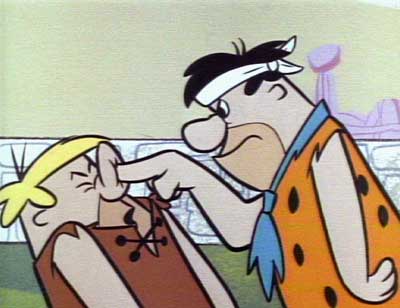
Of course, some fathers are idiots, and some are worse than that.  But pop culture has portrayed almost all fathers as idiots for decades.  As far as I can tell, that trend goes at least as far back as "The Flintstones", where Fred Flintstone constantly tries idiotic schemes that get him and his reluctant accomplice, Barney, in serious trouble.  Invariably, Fred blames Barney, and Wilma and Betty rescue them both.

Again, if pop culture had portrayed dads as buffoons only occasionally, that would be fine, even realistic.  But entertainers have portrayed dads as buffoons universally, and I suspect that has damaged the concept of fatherhood (and by extension, family) in the minds of countless consumers of pop culture. 

It's ironic (and encouraging), then, that a blood-and-gore-soaked series like "The Walking Dead" would promote the classicallyly wholesome idea of the father as hero.