EBR 1190RX - Erik Buell Racing | On Two Wheels - YouTube
Contrary to Zack Couts' narration, the real question is not whether EBR's new bike is any good. The real question is whether EBR's new bike is good enough to compete with the best from Japan, Italy and Germany.
Wait... Americans contending with Japan, Italy and Germany? Where have I heard that before?
Saturday, June 7, 2014

Wednesday, June 4, 2014
Champion Boxer Trains With CrossFit Coaching Staff
 Robert "The Ghost" Guerrero has an incredible resume.
Robert Joseph Guerrero (born March 27, 1983 in Gilroy, California) is an American professional boxer. Nicknamed The Ghost, he is the current interim WBC welterweight champion. He is also a former IBF Super Featherweight world champion, a former interim WBA and WBO lightweight champion and a former two-time IBF featherweight champion. He vacated the IBF Super Featherweight belt due to his wife's battle with leukemia. Guerrero's coach is Ruben Guerrero. He is managed by both Bob Santos and Luis Decubas Jr.In case you weren't counting, those are six different championships in four different weight classes. After going undefeated since 2006, he lost to Floyd Mayweather on 4 May 2013.
Apparently, Guerrero thought part of the reason he lost to Mayweather is that - in stepping up to a higher weight class - he simply could not out-fight a bigger, stronger athlete who is also arguably one of the most talented boxers ever.
He doesn't explain how, but Guerrero happens to know Dave Castro, former Navy SEAL and CrossFit HQ's programming director. Castro somehow convinced Guerrero to make CrossFit his strength and conditioning program. Warning: cursing ahead.
Castro chose Brian "Tosh" Chontosh to train Guerrero.
Major Brian R. Chontosh (born 1974 in Rochester, New York) is a retired United States Marine Corps officer who was awarded the Navy Cross for his heroic actions during the 2003 Invasion of Iraq. At the time, he was a platoon commander for Weapons Company, 3rd Battalion, 5th Marines, 1st Marine Division.You can watch part of a presentation Tosh gave to the American Society of Exercise Physiologists here.
If I could choose anyone to coach any athlete, I think the first thing I'd do is ask Kelly Starrett to identify inefficiencies in his movement and fix them. Here's a video of Starrett explaing pull-up mechanics.
Tosh did that, but Starrett is the master when it comes to the mechanics of athletes. Also, boxers need to stay loose to be quick, and Starrett is the the mobility guru.
I like that Castro brought in Chris Spealler. Spealler wrestled in college, so he's well acquainted with combative sports. Perhaps even more importantly, the CorssFit Games have no weight classes, and at 5'5" and 150 lb, Spealler is accustomed to using efficiency to beat much bigger, stronger athletes.
You can watch a perfect example of that in this video of the 2010 CrossFit Games event named "Amanda", which pairs two very technical movements, muscle-ups and snatches.
Where bigger, stronger athletes muscled their way through those movements, then fatigued near the end and were no longer able to do so, Spealler's impeccable technique made him more efficient, wasting much less energy and carrying him through the end with what looks like ease (it isn't, but Spealler makes it look easy).
Spealler is also an outstanding coach, which you can see from the Guerrero video. I really would've liked to see Spealler as Guerrero's strength and conditioning coach. Anyway, I'm not as familiar with Tosh, but I'm sure he's doing a great job.
My favorite part of the Guerrero video, though, is where they talk with his head coach (and father), Ruben.
I like what I see... he's using his hips. He's bending, punching up, and that's more explosive right there... And before it was really hard to get him to do that. He wouldn't really do it. He would do it, but only when I told him to do it.At the CrossFit Level 1 seminar I attended, the coaches preached over and over that the most powerful movements begin at the hips and radiate outward to the extremities. That is true whether one trows a ball, swings a bat or throws a punch. Spealler makes that point very clear in the video. The best way to train that physical adaptation (regardless of ones sport) is to first strengthen the hips using squats and deadlifts, then increase power and coordination with the Olympic lifts. Sport-specific training then applies the adaptation to the skills necessary to compete in the sport.
CrossFit HQ makes some big claims about what CrossFit can do for an athlete, and they've always insisted on testing their claims. The CrossFit Games are the ultimate testing ground for those claims, but few world champions have been willing to apply CrossFit to their training. That makes sense. After all, if their current programming made them champions, changing it could mean flirting with disaster.
Robert Guerrero will fight Yoshihiro Kamegai on 21 June 2014 at the StubHub Center in Carson, CA, where the 2014 CrossFit Games will take place from 25-27 July, appropriately enough. We'll get to see then if CrossFit can really make a world champion even better.
Actually, we'll really get to see that if/when Guerrero fights Mayweather again. Good luck, Ghost!
Can we mere mortals who'll never be world champions at anything learn from Guerrero's training? Yes. Tosh evaluated Guerrero's movement, identified inefficiencies and weaknesses, then spent a lot of time training him on technique before going heavy or adding a lot of volume.
CrossFit HQ emphasizes over and over that we should work on technique first, then add intensity, then add volume. Too many coaches and athletes neglect that progression with disastrous results. They skip right over technique, jump head first into intensity or - even worse - volume, and injure themselves. Then they blame CrossFit, even though they failed to follow CrossFit's prescription.
So, remember, whether you're a champion (like Guerrero) or ordinary (like me), the progression and priority goes:
- Technique
- Intensity
- Volume
Happy training!
Monday, May 26, 2014
Even More Rippetoe on PJ Media... and the NYT!
I've really been slacking on writing. Hey, it's a hobby, not a job. Let's get to the important stuff. As always, follow the links to read the articles in their entirety.
First, Coach Rip explains the difference between training and working out.
 |
| From PJ Media |
That makes “working out” the same thing as “exercise.” The term “exercise” best describes a physical activity performed for the sake of the effect it produces on your body today — right now — or immediately following the workout. If you’re just exercising, the workout itself is the point. Yoga, Pilates, cardio on the treadmill, a group class of any kind — basically punching your time card at the gym is “exercise.” For most people, “exercise” probably involves doing the same thing in the gym every time you go, because the effect is predictable. You want to get hot, sweaty, and tired, because it makes you feel that something positive has occurred. And it has. For many people, the acute effect of “exercise” is all that is necessary for an improvement in their physical wellbeing.
The modern fitness industry is built exclusively around the “exercise” model....
“Training” is the process of moving from one state of physical preparedness to another. The individual workouts that compose the elements of the process are important not in and of themselves, but because their cumulative effect accomplishes a specific definable physical goal.
To an athlete who is “training” for a performance goal, be it a marathon or a weightlifting meet, the accumulated, increasing stress that characterizes “training” must be specific to the performance goal. This means that “training” must be carefully planned in advance to produce a specific adaptation at a specific point in time. This planning differentiates “training” from “exercise.”In other words, training is physical activity with a purpose - an end goal - in mind. I'd add that, even if you're not a competitive athlete, even if you don't plan to run a marathon or compete at a weightlifting meet, training with a purpose is the way to go. Set a reasonable goal (even if it seems arbitrary at first) and train for it. Achieving a goal is motivating, and will help you stick with your program.
I disagree with Coach Rip on one point.
Corporate gyms are counting on you to come in about three days per week, mess around on the machines for 20 minutes, ride the treadmill while you watch television for 30 minutes, hit the sauna, the shower, and then the parking lot. They want you there for an hour, they want you to bring in a friend to sign up, and then they want you gone.Actually, corporate gyms count on you to not come in. Their business model is built on the fact that as many as 4/5 people don't use their gym memberships. If everyone with a gym membership actually used them, the gyms wouldn't have enough room for their clients. That's how they keep their membership fees low.
Next, Coach Rip explains why you shouldn't be doing LSD. No, not acid (although that too is advisable)! He means, "long, slow distance", which is - traditionally - the cornerstone of endurance training. In this case, he begins with a caveat.
If you are a competitive distance runner or cyclist who is serious about your sport, this article has not been written for you. This highly informative discussion is intended for those people who have taken seriously the advice of doctors, physical therapists, exercise physiologists, and the popular media’s dutiful reporting on these sources of common misinformation about what kind of physical activity is best for your long-term health and continued ability to participate in the business of living well.He then explains why "cardio" isn't as beneficial as we've been led to believe. For example:
 |
| From PJ Media: This does not look like LSD. |
The cumulative effects of high-volume low-intensity work are catabolic, i.e. they produce a metabolic environment that is destructive of lean muscle mass. It’s not merely that running does not produce more muscle size and strength; running at high mileages actively destroys muscle mass. This is why elite cyclists and marathoners have a ribcage that is visible through their corporate sponsorship jerseys.
The high-mileage cyclist is always trying to recover from training, but by its very nature high-volume endurance work is extremely difficult to recover from. When you’re 25, it’s no big deal. When you’re 40, it’s a bigger deal. When you’re 60, it’s a potentially very bad deal.He also explains (again) what makes strength training so beneficial. For example:
Strength training works in two separate ways, that are actually impossible to separate.
First, the exercises teach your nervous system to more efficiently use your muscles. Untrained muscles are reluctant to participate fully when asked to contract, and one of the ways strength training makes you stronger is by teaching your nervous system to call more of your muscle fibers into contraction when you work against a load.
Strength training also builds muscle mass, because a bigger muscle generates more force than a smaller muscle. And muscle mass is the body’s metabolic “bank.” It is the storehouse of protein and amino acids, carbohydrate, and water. Muscle mass is where energy stored as fat is converted to movement and heat.
Numerous studies have shown that the loss of strength and muscle mass is a predictor of mortality, not just in an aging population but also as the result of acute loss due to injury or immobilization. For examples:
http://www.ncbi.nlm.nih.gov/pubmed/17537093
http://www.ncbi.nlm.nih.gov/pmc/articles/PMC2453303/
http://ajcn.nutrition.org/content/86/5/1339.fullS
http://www.ncbi.nlm.nih.gov/pubmed/10795731
http://www.ncbi.nlm.nih.gov/pubmed/19366909
It’s hard to separate these two effects because the body adapts to a force-production stress by adapting both of these strength mechanisms at the same time. The body adapts to stress by getting better at handling it, and since strength is a function of both muscle size and nervous system efficiency, both improve together.The article leaves unanswered a question I assume many people would have: what to do if one wishes to improve strength and endurance? The answer is interval training. In the following video, you can see Jason Khalipa - a 220 lb professional athlete who can move serious weight - improving his endurance by running 10 intervals of 800 meters (1/2 mile) with a 1:1 work:rest ratio.
Jason's endurance training was so effective that he took first place in the 1/2 marathon rowing event at the 2013 CrossFit games.
That brings up another point. Contrary to what my high school cross country coach told me, LSD should not be the cornerstone of endurance training. Intervals should be. I highly recommend CrossFit Endurance for those who want to train for endurance sports, but don't want to make themselves weak.
I don't want to give the impression that one can win a marathon one week and a weightlifting meet the next, but as Jason Khalipa and every other CrossFit Games competitor demonstrate, it is possible to train for both strength and endurance.
Now the fun stuff. Coach Rip explains how to build your own gym at home and why.
Not everybody who wants to train for strength can fit a gym membership into their lifestyle. Scheduling problems, the cost, travel problems from home or work, the absence of an adequately equipped facility in the market, or simply the dislike of a commercial gym environment motivates many people to invest in a home gym.
A serviceable home gym for barbell training need not be a gigantic investment, and in fact should be very simple. A bar, some plates, a rack of some type to facilitate the squat and the pressing exercises, a simple flat bench for the bench press, and a platform for deadlifts are all that is absolutely required. For power cleans and snatches, a few bumper plates are quite useful but not absolutely necessary.
 |
| From Rogue Fitness |
I plan on building a home gym in the near future. I'll post pics when I finally get around to it.
Finally, to the New York Times. No, Coach Rip isn't writing for the NYT, but a NYT author discovered Starting Strength.
The book came in the mail and then I went to the gym and, per Mr. Rippetoe’s instructions, did three sets of five reps in the squat, dead lift and standing press. Then I went home and drank milk. Two days later, I did three sets of five in the squat and the bench press. I repeated this basic pattern, alternating the dead lift with the power clean, for a year, adding a little more weight to the bar in every lift, during every session.
Now for the astonishing part: It worked. I was able to lift a tiny bit more every single time, like magic — or, rather, like Milo of Croton, the ancient Greek wrestler who is said to have lifted a newborn calf and then lifted it every day thereafter, as it grew, until Milo carried a full-grown bull. In my own case, I eventually squatted 285 pounds, dead-lifted 335 and bench-pressed 235. Those numbers will not impress strength coaches — I weighed 215, after all — but they were a marvel to me.The human body hasn't changed all that much since prehistory. The basics in old Milo's day are still the basics today. We have more precise equipment than he did, but lifting heavy things in slowly increasing increments is still the best way to grow stronger.
Amazing, isn't it?
Thursday, March 27, 2014
Gun Trafficking Democrat Honored By The Brady Campaign
Just yesterday I wrote about California State Senator Yee (D - San Francisco), who was arrested for corruption, bribery and gun trafficking. Yee was famous for his anti-2nd-Amendment activism. Now it turns out the Brady Campaign to End Gun Violence honored Yee for his efforts.

For his commitment to ending gun violence, Assembly Speaker pro Tem Leland Yee (D-San Francisco/Daly City) has been named to the Gun Violence Prevention Honor Roll by the Brady Campaign. The Brady Campaign will honor Yee and other state legislators from throughout the country who earned an A+ for working against gun violence at a reception during the National Conference of State Legislators in Nashville, Tennessee, on Wednesday, August 16, 2006.That has to be embarrassing.

Wednesday, March 26, 2014
More Rippetoe on PJ Media
I haven't written much the last few weeks, and in the mean time, Mark Rippetoe wrote three more articles in his series at PJ Media. So, let's take a look at them in chronological order. First, Coach Rip engages in a bit of heresy.
Not everybody that goes to the gym wants to lose weight.
This may come as a surprise to some of you who either need to lose a few pounds or think everyone wants to be skinny. Many underweight men would love to be bigger, stronger, and more physically imposing, and gaining muscular body weight is a simple process.
Popular culture is currently at war with the notion that a man should be big and strong, because popular culture is at war with the idea of independence and self-sufficiency, and a big strong man literally embodies the concept.

We are inundated daily by print and video advertising, as well as by essentially every non-action/adventure film, with images of men who weigh about 150 pounds at 5’9” (that’s 10 stone 10 for the Brits, and about 68 kg at 175 cm for the rest of Europe). The image of Obama’s “Pajama Boy” is burned indelibly into the national conscience, but it made a very small blister.Ah yes, Pajama Boy, the ideal "Liberal" "man" - small, weak and completely dependent on government.
If you doubt Coach Rip's assessment of the popular desire to keep men weak, recall celebrity fitness guru Tracy Anderson, whose weakness regime, in which women never lift more than three pounds and men never lift more than ten pounds, receives plenty of breathlessly adoring media coverage.
Coach Rip goes on to explain his program for gaining strength and body weight, which in the simplest terms amounts to lifting big, eating big and getting lots of rest.
You go to the gym three days per week, and you do a basic workout that consists of squats, overhead presses, bench presses, deadlifts, and power cleans. You squat every workout, alternate the two press variations, and deadlift or power clean every workout. The lifts are easy to learn, and barbells are commonly available in gyms all over the world — and can be purchased for use in a home gym. Sets of five reps have proven to work best for our purposes.
...
The things your body needs to recover from the work are food and rest — lots of both. This is really the hard part. Most people find it easier to train heavy than to eat enough to both recover from the training and to build the new tissue that adaptation to the work requires. If you want to do a program like this for muscular weight gain, you have to eat more than you want to, more than you’re accustomed to eating — perhaps as much as 6000 calories per day for the few months the program will take.He's absolutely right. The gym work is the easy (and fun) part. It's the recovery that gets me. Getting a minimum of eight hours of sleep per day is almost impossible for me. And eating that much is really difficult. If you're a naturally skinny dude like me, that means eating a lot of fat, because fat is the most calorie-dense macro nutrient. At least it's tasty!
But what if you're not a naturally skinny dude? What if you need to lose some fat? Coach Rip covers that in the comments.
Basically, a man who is already overweight (fat) is in a completely different anabolic state than a skinny underweight man. We advise that fat guys do the program on what is basically the Paleo diet, at about 3000kcal/day, as opposed to the advice for underweight guys, which is 4 meals/day and a gallon of whole milk.By the way, I'm lactose intolerant, so drinking a gallon of milk per day would kill me! Fortunately, I've discovered that I can drink half and half or heavy cream without trouble. Don't ask me why. I don't understand it. Also, the extra fat means I don't have to drink as much of it.
What about women? Coach Rip doesn't address the ladies in this article, though he does promise in the comments to do so later. I've never met a woman who actually wants to gain muscle mass, but some do for athletic reasons.
Do read the whole thing.
In the second article, Coach Rip addresses my favorite lift - the deadlift!
The deadlift may be the simplest and easiest exercise to learn in all of barbell training. You pick up a loaded barbell and set it back down, keeping the bar in contact with your legs the whole way.That's probably why it's my favorite.
“Kinetic chain” is an exercise term that refers to the musculoskeletal components (the “links”) of an exercise between the load (the barbell) and the base of support (your feet against the floor). The kinetic chain in the deadlift is essentially the entire body, and everything between hands and floor is doing its anatomically-determined proportion of the work of moving the bar
....
Here’s the best part about barbell training: if you use good technique, your anatomy sorts out each body part’s contribution so that you don’t have to.
These large exercises — essentially normal human movement patterns loaded with a barbell to make them progressively heavier — eliminate the need for dozens of smaller exercises, and the strength you obtain is directly applicable to your job of being an active human.That's why, as Coach Rip stated in an earlier article, isolation movements are a waste of time.
Unfortunately, the deadlift inspires fear in many people. After all, there really is a risk of injuring ones spine during a deadlift attempt. However, as Coach Rip explains, good technique is the key to safety.
 |
| Source: PJ Media |
Exercise strengthens muscles. If an exercise requires that you use certain muscles to perform the movement, and the movement is performed correctly, then the exercise strengthens all the muscles used in the movement as you lift progressively heavier weights. Doing it wrong doesn’t count, because poor technique means some part of the kinetic chain didn’t do its job — it failed to do the work, and therefore didn’t get strong. The use of less-than-perfect technique allows some of the muscles to weasel out of doing their job, then they fail to get strong, and then they cannot do their job.In other words, if you want a strong back - and you should, if you want to protect your spine - you need to deadlift. People of any age or athletic ability can perform deadlifts safely as long as they do so with good technique. Even pregnant women can. Aimee has through two pregnancies now.
Here's a side note on the subject:
By Workout 14.3, they mean the third workout of the 2014 CrossFit Open; the first step toward the 2014 CrossFit Games. Workout 14.3 is a deadlift-intensive event. You can watch a demo here.The world’s second-best performance on Open Workout 14.3 was set by a 39-year-old athlete from Buford, Ga.
...
Steven Platek completed the same number of reps as worldwide winner Austin Malleolo, but fell behind on the tiebreak time. Malleolo finished his last set of box jumps in 7:07, while Platek finished them in 7:17.

Most men start falling apart physically in their 30s. Mr Platek - and thousands like him - prove that isn't necessary, and strength training is the key to preventing that from happening. This was my favorite part of the article:
Four years ago, Platek wouldn’t have been excited by a workout with a lot of deadlifts. The former self-described meathead hurt himself deadlifting in his old globo gym, and thought his heavy lifting days were over.Again, good technique is crucial. Read both articles in their entirety.
...
It wasn’t until a friend suggested he try CrossFit that he eventually started to lift again and work on correcting his technique.
...
Now, after years of deadlifting and focusing on technique, his deadlift one-rep max is somewhere in the range of 625 lb.
The latest article in Coach Rip's PJ Media series covers the strict overhead press.
Pressing a barbell overhead is one of the oldest exercises in the gym. It might well have been the first exercise invented after the first barbell was discovered. Since it is performed while standing with the bar in the hands — after the bar is cleaned from the ground to the shoulders, or taken from the rack at shoulder height — the entire body is involved in the exercise. From the floor to the hands, the job of pressing the bar overhead is shared by all the muscles in the body.Notice a pattern here? Every movement trains the entire body.
Due to a poor understanding of the mechanics of the movement, doctors and physical therapists commonly advise against performing this perfectly natural and perfectly safe exercise. The alleged problem is an injury known as “shoulder impingement,” and nothing could be further from the truth. The correctly performed press (incorrectly-performed exercises do not count) is not only perfectly safe for the shoulders — more importantly, the press is the best exercise for keeping shoulders strong and injury-free.There's another pattern. Ignorance of technique leads people to blame injuries on a movement that actually prevents injuries by strengthening the muscles around a joint. A devotee of kettlebell training once told me the human body isn't designed to lift heavy things overhead with both hands, which is hilarious. But even educated people (doctors and physical therapists) make similar mistakes.
 |
| Source: PJ Media |
...what is the normal daily role of a “rotator cuff” muscle, and does it perform this function all by itself? Does it make your shoulder externally rotate, and that’s all? Or does it primarily function as one of several muscle groups that stabilize the head of the humerus in the glenoid, while also externally rotating the arm when you’re in a physical therapy office, lying on your side with a two-pound chrome dumbbell in your hand? The rotator cuff muscles are just another muscle group that helps hold the shoulder together, and they are best trained — and rehabbed — while performing this function.
The press is precisely the movement that uses all the shoulder muscles in this manner. Since they are functioning simultaneously with the other muscles that press the bar overhead, they are both strengthened with and protected by the rest of the muscles that operate the shoulder girdle. This is their normal function — synergy, not isolation, and the best way to make them strong and healthy.This training philosophy is diametrically opposed to that which is most popular today - sitting at enormously complex, expensive machines and isolating the smallest muscles possible. But if you think about it, it makes a whole lot more sense.
Gun Grabbing CA Democrat Charged With Gun Trafficking
As I've stated before, gun grabbing politicians desire "gun control" because they project their own lawlessness onto the rest of us.
State Sen. Leland Yee has been charged with conspiring to traffic in firearms and public corruption as part of a major FBI operation spanning the Bay Area, casting yet another cloud of corruption over the Democratic establishment in the Legislature and torpedoing Yee's aspirations for statewide office.

Yee and an intermediary allegedly met repeatedly with an undercover FBI agent, soliciting campaign contributions in exchange for setting up a deal with international arms dealers.
At their first face-to-face meeting in January, "Senator Yee explained he has known the arms dealer for a number of years and has developed a close relationship with him," an FBI affidavit says, noting Yee told the agent the arms dealer "has things that you guys want."
Yee, D-San Francisco, highlights a series of arrests Wednesday morning that included infamous Chinatown gangster Raymond "Shrimp Boy" Chow, whose past includes a variety of charges including racketeering and drug crimes. Targets of the early-morning raids appeared in federal court in San Francisco on Wednesday afternoon.
A 137-page criminal complaint charges 26 people -- including Yee and Chow -- with a panoply of crimes, including firearms trafficking, money laundering, murder-for-hire, drug distribution, trafficking in contraband cigarettes, and honest services fraud.
Yee is charged with conspiracy to traffic in firearms without a license and to illegally import firearms, as well as six counts of scheming to defraud citizens of honest services. Each corruption count is punishable by up to 20 years in federal prison and a fine of up to $250,000, while the gun-trafficking count is punishable by up to five years and $250,000.
You can read the affidavit here. In Yee's case, the motivation may be even more sinister than typical projection. If Yee really is involved with a notorious Chinatown gangster and actually does know an international arms dealer, he may have desired to disarm law abiding people to protect his buddies. After all, criminals prefer disarmed victims.The charges are particularly shocking given that Yee has been among the state Senate's most outspoken advocates both of gun control and of good-government initiatives.
As disgusting as Yee and his fellow gun grabbing politicians are, at least we get to make fun of them.
Tuesday, March 25, 2014
No Correlation Between Saturated Fat and Heart Disease
 If you've been reading books and/or articles by Gary Taubes and watching documentaries like "Fat Head", you know an increasing number of scientists question the conventional wisdom that saturated fat is inherently harmful. You also know that the conventional wisdom was completely different not so long ago, and that the current conventional wisdom hasn't done much good.
Recently, the NYT published an article on a meta analysis that demonstrates that there is no correlation between saturated fat and heart disease.
...a large and exhaustive new analysis by a team of international scientists found no evidence that eating saturated fat increased heart attacks and other cardiac events....
...the new research, published on Monday in the journal Annals of Internal Medicine, did not find that people who ate higher levels of saturated fat had more heart disease than those who ate less. Nor did it find less disease in those eating higher amounts of unsaturated fat, including monounsaturated fat like olive oil or polyunsaturated fat like corn oil.
“My take on this would be that it’s not saturated fat that we should worry about” in our diets, said Dr. Rajiv Chowdhury, the lead author of the new study and a cardiovascular epidemiologist in the department of public health and primary care at Cambridge University.
...
Dr. Chowdhury and his colleagues sought to evaluate the best evidence to date, drawing on nearly 80 studies involving more than a half million people. They looked not only at what people reportedly ate, but at more objective measures such as the composition of fatty acids in their bloodstreams and in their fat tissue. The scientists also reviewed evidence from 27 randomized controlled trials – the gold standard in scientific research – that assessed whether taking polyunsaturated fat supplements like fish oil promoted heart health.So, if saturated fat is not the problem, what is?
 |
| The most damaging item here is the bun. |
The smaller, more artery-clogging particles are increased not by saturated fat, but by sugary foods and an excess of carbohydrates, Dr. Chowdhury said. “It’s the high carbohydrate or sugary diet that should be the focus of dietary guidelines,” he said. “If anything is driving your low-density lipoproteins in a more adverse way, it’s carbohydrates.”Boy, that sounds a lot like what people who the dietary establishment maligned - like Dr. Atkins, Gary Taubes and Dr. Cordain - have been saying for years (not that they agree with each other on everything).
What about other fats?
The researchers did find a link between trans fats, the now widely maligned partially hydrogenated oils that had long been added to processed foods, and heart disease. But they found no evidence of dangers from saturated fat, or benefits from other kinds of fats.
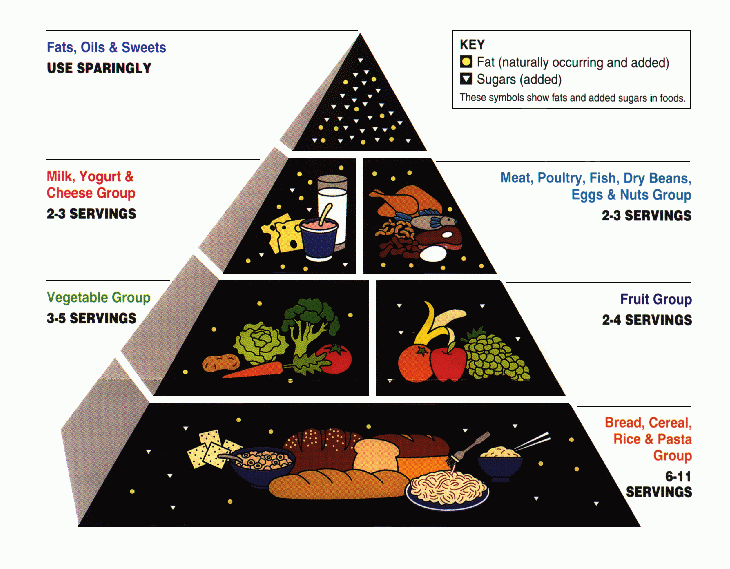 |
| 1992 USDA Food Pyramid (Wikipedia) |
 |
| 2011 USDA My Plate (Wikipedia) |
In 2011, the USDA updated their dietary recommendations with their "My Plate" graphic. It seems to recommend a little more protein, but it's mostly the same old story - lots of carbohydrate, little protein and almost no fat.
Furthermore, a large portion of those carbohydrates are made up of breads and cereals, which are most likely baked with hydrogenated vegetable oils, which - unlike natural saturated fats - really do damage your heart.
 |
| AHA Seal of Approval (Heart.org) |
The American Heart Association doesn't do much better in their recommendations. For example, let's take a look at some of the foods that bear the AHA's seal of approval.
Let’s look at the (ahem) nutrition in some of these heart-protecting foods. In a serving size that provides just 118 calories (boy, that’ll get you through the morning, won’t it?), Honey Nut Cheerios contain 23 grams of refined carbohydrates. Almost 10 of those grams are pure sugar. A cup of West Soy vanilla soy milk contains 21 grams of carbohydrates, including 10 grams of sugar. The instant oatmeal contains 31 carbohydrates including 12 grams of sugar, and the V-8 fusion juice may as well be a Coca-Cola: 25 grams of sugar in one cup.
Actually, it's even worse than that, because the serving sizes are unrealistic. One packet of instant oatmeal or one cup of Cheerios would barely fill up my four-year-old.So well-meaning people filling their grocery carts with products bearing the American Heart Association’s seal of approval could easily end up on a diet high in refined starches and sugars and think they’re doing their hearts a favor.

The AHA puts its seal of approval on foods that are essentially refined flour and sugar with some hydrogenated vegetable oil for "good" measure. Many ordinary people trust governmental organizations like the USDA, an non-governmental organizations like the AHA, to help them make wise decisions about which foods to eat to maintain or improve their health. Clearly, those organizations are not doing their job. And the results show in the chart I linked at the top of this post. That, ladies and gents, is failure on a massive scale.
 |
| Mmmmm... steak! |
So, here's the bottom line: don't fear fat - at least not the natural kinds. Avoid the chemically processed kinds of fats, like vegetable oils, margarine, vegetable shortening, etc. (you know, all the stuff they used to say was better for us), and enjoy the natural kinds of fats, like olives, olive oils, avocados, marbled steaks and butter (you know, all the stuff they used to say would kill us).
For a much more comprehensive discussion on the subject of fats from a dude who's been preaching this stuff for years, see Mark Sisson's Definitive Guide to Fats. I also recommend his Definitive Guide to Oils.
Subscribe to:
Posts (Atom)