 If you've been reading books and/or articles by Gary Taubes and watching documentaries like "Fat Head", you know an increasing number of scientists question the conventional wisdom that saturated fat is inherently harmful. You also know that the conventional wisdom was completely different not so long ago, and that the current conventional wisdom hasn't done much good.
Recently, the NYT published an article on a meta analysis that demonstrates that there is no correlation between saturated fat and heart disease.
...a large and exhaustive new analysis by a team of international scientists found no evidence that eating saturated fat increased heart attacks and other cardiac events....
...the new research, published on Monday in the journal Annals of Internal Medicine, did not find that people who ate higher levels of saturated fat had more heart disease than those who ate less. Nor did it find less disease in those eating higher amounts of unsaturated fat, including monounsaturated fat like olive oil or polyunsaturated fat like corn oil.
“My take on this would be that it’s not saturated fat that we should worry about” in our diets, said Dr. Rajiv Chowdhury, the lead author of the new study and a cardiovascular epidemiologist in the department of public health and primary care at Cambridge University.
...
Dr. Chowdhury and his colleagues sought to evaluate the best evidence to date, drawing on nearly 80 studies involving more than a half million people. They looked not only at what people reportedly ate, but at more objective measures such as the composition of fatty acids in their bloodstreams and in their fat tissue. The scientists also reviewed evidence from 27 randomized controlled trials – the gold standard in scientific research – that assessed whether taking polyunsaturated fat supplements like fish oil promoted heart health.So, if saturated fat is not the problem, what is?
 |
| The most damaging item here is the bun. |
The smaller, more artery-clogging particles are increased not by saturated fat, but by sugary foods and an excess of carbohydrates, Dr. Chowdhury said. “It’s the high carbohydrate or sugary diet that should be the focus of dietary guidelines,” he said. “If anything is driving your low-density lipoproteins in a more adverse way, it’s carbohydrates.”Boy, that sounds a lot like what people who the dietary establishment maligned - like Dr. Atkins, Gary Taubes and Dr. Cordain - have been saying for years (not that they agree with each other on everything).
What about other fats?
The researchers did find a link between trans fats, the now widely maligned partially hydrogenated oils that had long been added to processed foods, and heart disease. But they found no evidence of dangers from saturated fat, or benefits from other kinds of fats.
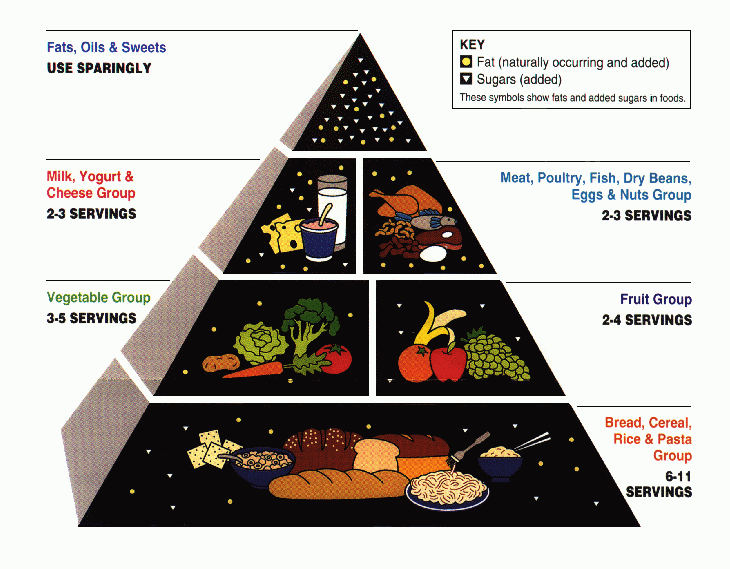 |
| 1992 USDA Food Pyramid (Wikipedia) |
 |
| 2011 USDA My Plate (Wikipedia) |
In 2011, the USDA updated their dietary recommendations with their "My Plate" graphic. It seems to recommend a little more protein, but it's mostly the same old story - lots of carbohydrate, little protein and almost no fat.
Furthermore, a large portion of those carbohydrates are made up of breads and cereals, which are most likely baked with hydrogenated vegetable oils, which - unlike natural saturated fats - really do damage your heart.
 |
| AHA Seal of Approval (Heart.org) |
The American Heart Association doesn't do much better in their recommendations. For example, let's take a look at some of the foods that bear the AHA's seal of approval.
Let’s look at the (ahem) nutrition in some of these heart-protecting foods. In a serving size that provides just 118 calories (boy, that’ll get you through the morning, won’t it?), Honey Nut Cheerios contain 23 grams of refined carbohydrates. Almost 10 of those grams are pure sugar. A cup of West Soy vanilla soy milk contains 21 grams of carbohydrates, including 10 grams of sugar. The instant oatmeal contains 31 carbohydrates including 12 grams of sugar, and the V-8 fusion juice may as well be a Coca-Cola: 25 grams of sugar in one cup.
Actually, it's even worse than that, because the serving sizes are unrealistic. One packet of instant oatmeal or one cup of Cheerios would barely fill up my four-year-old.So well-meaning people filling their grocery carts with products bearing the American Heart Association’s seal of approval could easily end up on a diet high in refined starches and sugars and think they’re doing their hearts a favor.

The AHA puts its seal of approval on foods that are essentially refined flour and sugar with some hydrogenated vegetable oil for "good" measure. Many ordinary people trust governmental organizations like the USDA, an non-governmental organizations like the AHA, to help them make wise decisions about which foods to eat to maintain or improve their health. Clearly, those organizations are not doing their job. And the results show in the chart I linked at the top of this post. That, ladies and gents, is failure on a massive scale.
 |
| Mmmmm... steak! |
So, here's the bottom line: don't fear fat - at least not the natural kinds. Avoid the chemically processed kinds of fats, like vegetable oils, margarine, vegetable shortening, etc. (you know, all the stuff they used to say was better for us), and enjoy the natural kinds of fats, like olives, olive oils, avocados, marbled steaks and butter (you know, all the stuff they used to say would kill us).
For a much more comprehensive discussion on the subject of fats from a dude who's been preaching this stuff for years, see Mark Sisson's Definitive Guide to Fats. I also recommend his Definitive Guide to Oils.

No comments:
Post a Comment