Thursday, February 13, 2014

100% of 501(C)(4)'s Audited By IRS Were Conservative

Surprised?: All 501(C)(4)'s Audited By IRS Were Conservative - Carol Platt Liebau

No.  Not surprised.  Not even a little.
Less than two weeks after President Obama insisted that there wasn't even a"smidgen of corruption" involved in the IRS targeting scandal, it appears that the scope of that scandal is widening. 
... of the groups the IRS selected for audit, 100% were right-leaning.
Not a smidgen...


I'm sure it's a mere coincidence. 


Tuesday, February 11, 2014

Lone Survivor Movie Review

This review is very late.  I watched the movie about three weeks ago.  I read the book during my first tour in Afghanistan.  I recommend reading the book somewhere other than Afghanistan.

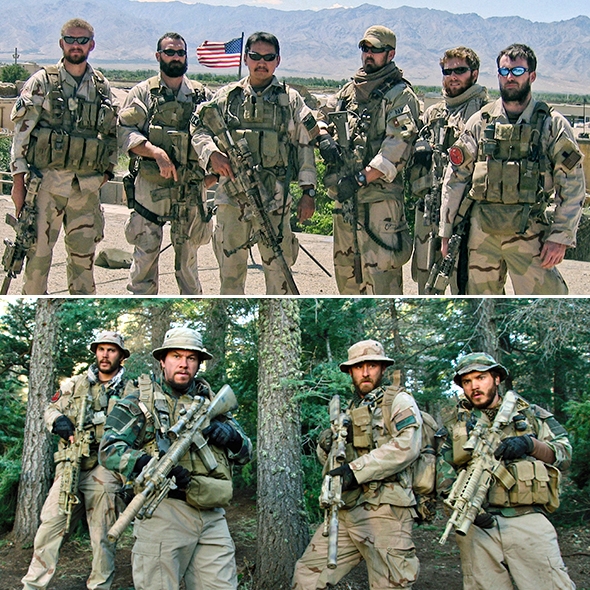
The real deal (above) and the actors (below)
I waited to write about it because I wanted to mull it over.  It's that important.

First, it's one of the top three war movies I've watched.  The other two are "Band of Brothers" (actually a miniseries, but I think it counts, and based on another true story and far better book) and "Saving Private Ryan" (fiction inspired by several real stories).

I loved the realism:

  1. Telecommunications are the bane of every combat unit. 
  2. No shooting from the hip.  Even the Taliban aimed, though not nearly as skillfully as the SEALs, which is realistic.
  3. Grenades do not make giant fire balls.
  4. Finite ammo: fighters on both sides employ fire discipline, change magazines and even (gasp!) run out of ammo.
  5. Shooting, moving and communicating between teammates, and I don't just mean the SEALs. 
  6. Referring to each other by call sign over TACSAT. 
  7. The silly names Servicemen give serious matters - and the gallows humor between friends at war. 
Other stuff I loved: 
  1. Mark Wahlberg as Marcus Luttrell, the actual Lone Survivor.  This is the same dude who starred in movies as disparate as "The Fighter" and "Ted", for goodness' sake!  If you would've told me during his "Marky Mark" days that he'd grow into such a talented, versatile actor, I'd have said you were crazy.  As if that wasn't enough, he seems to genuinely respect and honor the people whose story he tells. 
  2. Taylor Kitsch as Medal of Honor recipient Michael "Murph" Murphy.  Yes, that Murph.  The man is a legend, and Mr Kitsch honored Murph's memory with his performance.
  3. Ben Foster as Matt "Axe" Axelson.  
  4. Eric Bana as Erik Kristensen.  It was a relatively small role for a big name actor, but Mr Bana brought a dignity and details (see the link) to the role that prove the people who made this movie really cared about the subjects of the story.  
  5. Marcus Luttrell's cameos.  Look for them. 
  6. They left intact Marcus' belief - expressed in the book - that the fact he lost his rifle, and it kept its zero, was a genuine miracle. 
  7. The people portrayed as the most heroic are Afghans
What disappointed me:
  1. As with most books adapted to film (not "The Hobbit"!), time constraints forced the film makers to leave many details out.  Read the book! 
  2. The film makers embellished the ending in typical Hollywood fashion.  I understand why they did it, but I think the real ending is more compelling.  No, I won't explain.  Read the book! 
Why this movie is important: 

First, civilians, from the low-information non-voter on the street to policy makers in DC, have a concept of special operations troops as techno-magical ninjas that can accomplish impossible missions with minimum political risk.  Stories like "Lone Survivor", "Black Hawk Down" (read the freaking book!) and "Bravo Two Zero" remind us that these men, though far from normal (yes, I mean exactly that), are still human.  They screw up.  Or, they don't, and circumstances conspire to screw them up.  If war is "policy by other means", then there is no such thing as a politically safe way to engage in it.  Furthermore, these men are real people with real families who face real, deadly consequences.  Those consequences - because of the nature of their missions - often affect entire countries.  Politicians need to be a lot more careful about what missions they assign these men, and why. 

By the way, Hollywood is really into remakes right now, even remaking all kinds of movies that should never be remade.  If there's on movie that desperately requires a remake, it's Bravo Two Zero.  But, even if they do, read the freaking book!

Second, the training these men go through to become special operators is brutal, some would say sadistic.  If you haven't watched the Discovery Channel series "Surviving the Cut", do so.  You can find in on Netflix, and I'm sure elsewhere.  If you haven't experienced combat, you may be tempted to think that kind of brutality unnecessary, but "Lone Survivor" demonstrates why it's essential.  The kind of man who did what those four SEALs did is not common.  He isn't average.  He isn't even normal.  And one can't identify that kind of man with psychological profiles or any method other than making their "training" (it's not really training; it's testing) so hellaciously painful, that the many who lack the ability, the will, or both simply quit.  They self-identify.  The few who survive the cut never even consider quitting.  Ever.  You see that attitude dramatized more effectively in "Lone Survivor" than in any other movie I've watched. 

The controversy:

Screw the controversy.  The only reason there is any controversy (and there are oodles) is that "Liberals" demand American Servicemen be portrayed in only two roles - monster and victim - often both, especially we who've fought from Vietnam until now.  If you hold no such belief, you'll find "Lone Survivor" a gut-wrenching experience that pays fitting tribute to the people it portrays, and (importantly) does so with artistry worthy of recognition it will never receive from "Liberals".

Sounds familiar.

If you haven't already, watch these trailers.


Sub 3 Minutes with Josh Bridges - YouTube


"I wasn't watching you.  I was watching my wife." ~ Dave Lipson


Well played, Dave.  Well played... 


But seriously, Josh Bridges is one of my favorite CrossFit athletes, especially since he's a fellow current active duty Serviceman and war veteran.  Bridges for 2014! 

Monday, February 10, 2014

CrossFit Athlete Wins Gold at 2014 USAW Junior Nationals

“I do a lot of Olympic lifting, but I don’t do as much as most of these lifters do.” ~ Lauren Fisher

CrossFit athlete, Lauren Fisher, took three gold medals in her weight class (63 kg = 139 lb) and won best female lifter at the 2014 USAW Junior Nationals.

  • snatch (75 kg = 165 lb) 
  • clean and jerk (102 kg = 225 lb) 
  • total (177 kg = 390 lb)

When a generalist beats a bunch of specialists at their specialty, you know she's doing something right.

Source: Hook Grip
A little background on Ms Fisher.


UPDATE: Ms Fisher finished 10th at the 2014 Junior World Championship - amazing for an athlete that doesn't specialize in Olympic weightlifting, from a country that isn't very competitive in Olympic weightlifting.

The Link Between Health and Fitness

I'm very pleased to see that Mark Rippetoe, of "Starting Strength" fame, is writing for PJmedia.com.  That means I don't have to soil my computer by going to the Huffington Post to read his articles.  You can read his first two articles for PJ Media here and here.

In the first article, he made a statement that really caught my eye. 
As we grow older, one of the primary regrets is that we can’t do the things we used to be able to do. Staying strong solves many of these problems. 
Staying strong also prolongs life, which is a good thing if you’re strong enough to enjoy it. A 2008 British Medical Journal meta-analysis showed that strength levels correlated better with longevity than any other parameter. Better than BMI, and better than cardiorespiratory fitness. 
Stronger people live longer. Which is very interesting considering the fact that we are so often told how important it is to walk/jog/bike, and that we are almost never told to do our deadlifts and squats.
games.crossfit.com: click to enlarge
A quick Google search resulted in the BMJ link to the study.  The researchers conclude...
This review shows the value of objective measures of physical capability as predictors of subsequent mortality in older community dwelling populations. 
Rippetoe's comment and the researchers' conclusion remind me a lot of something Greg Glassman (CrossFit CEO) said.
Health can now be concisely and precisely defined as increased work capacity across broad time, modal, and age domains. Work capacity is the ability to perform real physical work as measured by force x distance / time (which is average power). Fitness is this ability in as many domains as possible. 
... 
Fitness can be graphed in two-dimensions with duration of effort on the x-axis and power on the y-axis. At each duration, we average your power capacity across a variety of modal domains (skills and drills). This creates a power curve, the area under which is your work capacity across broad time and modal domains (aka fitness). 
We can now add a third dimension to this graph, the z-axis, which is age. By reassessing your two-dimensional fitness at various times throughout your life, we graph the form of a solid. The power curve takes on the shape of a plateau or blanket. This three-dimensional graph is a defining measure of health. Health, therefore, is nothing other than sustained fitness. 
Both those statements coincide with a study published in Science Daily that fitness increases longevity by warding off frailty.
Most participants (7183) reported fairly high relative fitness at the start of the study compared with 1019 who were frail. These relatively fit people generally stayed healthy and those who were frail at the start were most likely to die. As participants aged, their frailty level increased.
As Coach Glassman said"What puts people in nursing homes?  It's loss of functional capacity."

A Brazilian study published in 2012 concluded that...
...aerobic fitness is strongly related to survival, but our study also shows that maintaining high levels of body flexibility, muscle strength, power-to-body weight ratio and co-ordination are not only good for performing daily activities but have a favorable influence on life expectancy.
Aerobic endurance, flexibility, strength, power, coordination... where have I seen those terms used to define fitness before?  Oh, that's right, they're part of CrossFit's definition of fitness!  CrossFit claims that one can determine ones fitness by measuring competence in the ten components of fitness...

  1. Cardiovascular/respiratory endurance
  2. Stamina
  3. Strength
  4. Flexibility
  5. Power
  6. Speed
  7. Coordination
  8. Agility
  9. Balance
  10. Accuracy

I've heard and read many criticisms of CrossFit's definition of fitness, which - stated most succinctly - is work capacity over broad time and modal domains.  Critics often claim it's too narrow and doesn't account for health.  I always ask the critic to provide a better definition.  All but one have failed to provide any definition at all, and the one that did provide a definition proceeded to contradict himself by criticizing CrossFit's definition of fitness as too narrow while simultaneously claiming all definitions of fitness are equally valid.

Try to square that circle.

Fortunately, a growing body of scientific evidence demonstrates that fitness can be measured objectively, which is necessary if we want to move beyond the realm of mere opinion, and that objectively measured fitness is closely related to health and longevity.

To me, this is yet another case of science confirming the obvious.  It seems intuitively obvious to me that - as a general rule - fit people live longer, healthier, more active lives than people who are not fit.  There are exceptions, of course - the athlete that ruins his body by over-training, the lifelong health nut who dies of lung cancer, etc. - but exceptions do not prove a rule wrong.

So, keep up your fitness program, or start one if you haven't already.  I recommend CrossFit, of course, but whatever you do, make sure it includes basic strength training - squats, deadlifts and presses.  In the mean time, here's a video of people in their 60s doing things one normally wouldn't associate with that age... to inspire, of course!

Sunday, February 9, 2014

Why We Normally Don't Watch "The Biggest Loser"

As I explained before, Aimee and I don't normally watch "The Biggest Loser", because we disagree with their methods.  We did watch the most recent iteration (season 15), because Olympic weightlifter Holley Mangold participated in it.  Unfortunately (fortunately?), Ms Mangold was eliminated fairly early in the show, but we finished watching the season anyway.

Before
Now there's an international media uproar over season 15's winner, Rachel Fredrickson.
The incredibly slender Rachel weighed in at just 105lbs which, at a reportedly height of between 5-foot-4 and 5-foot-5, would make her classed as underweight on the Body Mass Index Scale used by doctors.
After


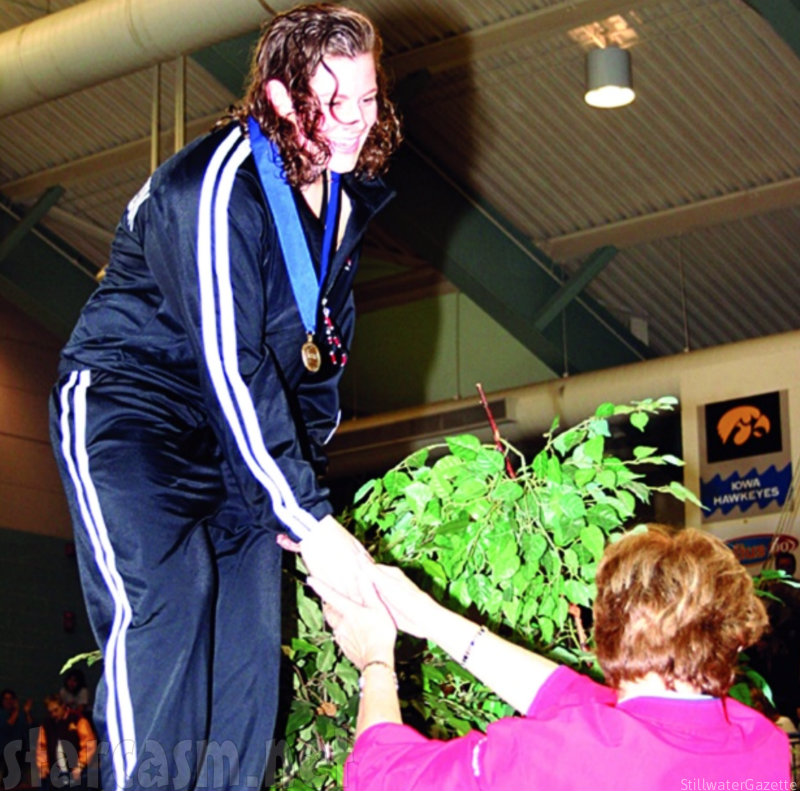
Ms Fredrickson claims she eats 1600 kilocalories a day and exercises "up to four times a day".  It's highly unlikely that level of caloric intake is sufficient to sustain that level of physical activity.  Ms Fredrickson is only 24, and a former nationally ranked swimmer, and I believe that provides further evidence that her "transformation" is far from healthy.  Compare the following photos, which juxtapose Ms Fredrickson at her fittest and now.

The "before" photo (from her competitive swimming days) is of much lower resolution, but I think you can still see the difference, especially when you enlarge the "after" photo.  In the "after" photo, Ms Fredrickson's face looks dehydrated, starved and exhausted.

Before


After

Now Look at her arm.  At her fittest, Ms Fredrickson was not a small girl.  Judging from her swimming photos and her height, a healthy, natural weight for Ms Fredrickson is probably between 130 lb and 150 lb.  At 105 lb she looks emaciated and frail.

My point is that, although I agree that Ms Fredrickson went to unhealthy lengths to win the title of "The Biggest Loser", nobody should be shocked.  Before season 15, I'd only watched one episode of the show, but even then I thought it was fairly obvious that the contestants and coaches went to unhealthy lengths to win.  After having watched a whole season, it's even more obvious to me that contestants starve and dehydrate themselves to "put up big numbers" at the weigh-ins.  I didn't need to read a former contestant's "tell all interview" to see that.

TV thrives on sensationalism, and a $250,000 grand prize and the fame that can go with it are powerful motivators.  They pretty much guarantee unhealthy results.  This may be the most dramatic case in point (I don't know if it is), but if it is, it's only more of the same.

In a strange way, that gives me hope.  I think it's likely that Ms Fredrickson went to extremes to win a prize, and now that she's won she'll go back to healthier habits.  Good luck, Rachel Fredrickson!

Obesity Is a Choice, Not a Disease

In another case of science confirming the obvious, a study conducted by the University of Minnesota concludes that telling people that obesity is a disease implies that they have no control over their weight (more importantly, their health) and discourages them from finding solutions by absolving them of responsibility. 
University of Minnesota researchers asked more than 700 adults to read one of three articles about obesity. 
One was a real article from the New York Times about the decision to classify obesity as a disease.
A second article focused on standard tips for managing weight, including having a weekly weigh-in and varying exercise to keep it interesting. 
The third piece argued that obesity is not a disease and emphasised [sic.] the importance of a person’s lifestyle to their health. 
... 
The obese men and men who read that obesity was a disease saw dieting for health as less important than the others.
They were also less concerned about their weigh, happier with their size and chose higher calorie sandwiches.
As with most things in life, the most important factor determining health and fitness is personal responsibility, especially in a country as wealthy and technologically advanced as the US.  Yes, genetics play a role, but as this chart from USA Today demonstrates, the obesity rate in the US rocketed from 13% in 1962 to 36% in 2010.  Even if the data is only 80% accurate, that's still an enormous increase in only 50 years.  A population's genetics simply cannot change that drastically in one generation.  Genetics are not the issue.

Another factor that comes up when discussing obesity in the US is poverty, because in the US the poor are fatter than the rich.
Wages were inversely related to BMI and obesity in a nationally representative sample of more than 6,000 adults – meaning, those with low wages had increased BMI as well as increased chance of being obese (Kim & Leigh, 2010).
Supposedly, this phenomenon is the result of "food deserts".
Many Americans reside in food deserts—communities where retailers offering fresh food are scarce but fast-food restaurants and convenience stores selling prepared foods can abound. 
... 
Gallagher says. “You can’t choose healthy food if you don’t have access to it.”
According to this theory, poor people tend to be fatter because they can't afford to eat healthy foods. 
NPR.org: Food deserts mapped from coast to coast


I've always thought this theory was a load of steer manure based on personal experience.  First, my family and I are immigrants.  We moved to the US in 1983 and lived in poverty for years, and eating fast food was an extremely rare treat for us precisely because eating at home was far more affordable.  Second, although Aimee and I are solidly middle class, we still eat out rarely because we have eight kids and cooking a healthy meal at home is far less expensive than eating at a fast food restaurant or eating "prepared foods".

Personal experience is anecdotal, but now we have empirical evidence that my hunch was right.   
three years and $500 million into the federal Healthy Food Financing Initiative, there's a problem: A study suggests it's not working. 
... 
When a grocery store was opened in one Philadelphia food desert, 26.7 percent of residents made it their main grocery store and 51.4 percent indicated using it for any food shopping, the report found. But among the population that used the new supermarket, the researchers saw no significant improvement in BMI, fruit and vegetable intake, or perceptions of food accessibility, although there was a significant improvement in perception of accessibility to fruits and vegetables...
As James Taranto puts it...
The results "mirror findings in the U.K., where researchers created a similar comparison of two neighborhoods in Scotland and observed no net effect on fruit and vegetable intake," 
...
It's not that most "food desert" denizens eat unhealthy food because grocers refuse to supply them with fruits and vegetables. Instead, grocers don't supply them with fruits and vegetables because the demand is insufficient. 
You mean poor people are endowed with free will and are therefore responsible for their own actions, just like everyone else?  Isn't that amazing?

So then, why do so many people refuse to admit that obesity is a matter of individual responsibility?  It seems to me that those claiming that the obese are helpless in their plight hail from the political left.  Leftists, as a general rule, don't believe in individual responsibility, and believe deeply in paternalistic, sugar daddy government.

If obesity is not a matter of individual responsibility, if instead it's the fault of those mean old Capitalists, that gives them an excuse (as if they ever need one) to demand more government intrusion in free markets - which is just another way of saying individuals' free will choices.

Before anyone claims that stating that obesity is a matter of individual responsibility is a form of "fat shaming", let's think about some questions.

What is more shameful; being helpless, or being in control of ones self?  What is more empowering; being at the mercy of outside forces, or having the power to control ones own actions?

The choice seems obvious to me.