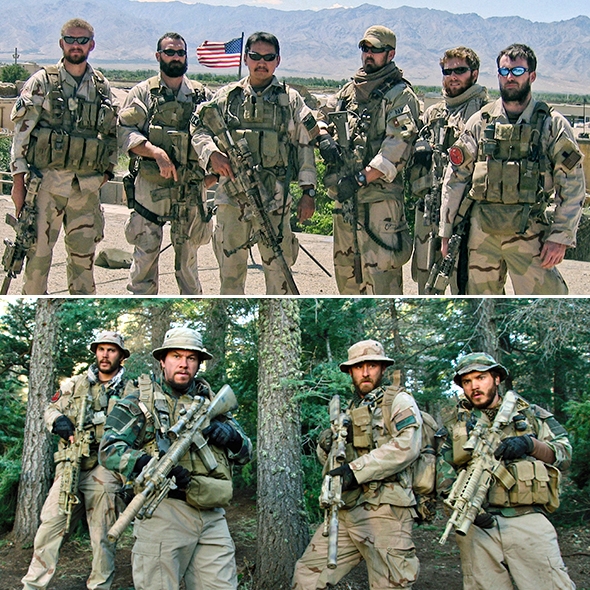
 |
| The real deal (above) and the actors (below) |
First, it's one of the top three war movies I've watched. The other two are "Band of Brothers" (actually a miniseries, but I think it counts, and based on another true story and far better book) and "Saving Private Ryan" (fiction inspired by several real stories).
I loved the realism:
- Telecommunications are the bane of every combat unit.
- No shooting from the hip. Even the Taliban aimed, though not nearly as skillfully as the SEALs, which is realistic.
- Grenades do not make giant fire balls.
- Finite ammo: fighters on both sides employ fire discipline, change magazines and even (gasp!) run out of ammo.
- Shooting, moving and communicating between teammates, and I don't just mean the SEALs.
- Referring to each other by call sign over TACSAT.
- The silly names Servicemen give serious matters - and the gallows humor between friends at war.
Other stuff I loved:
- Mark Wahlberg as Marcus Luttrell, the actual Lone Survivor. This is the same dude who starred in movies as disparate as "The Fighter" and "Ted", for goodness' sake! If you would've told me during his "Marky Mark" days that he'd grow into such a talented, versatile actor, I'd have said you were crazy. As if that wasn't enough, he seems to genuinely respect and honor the people whose story he tells.
- Taylor Kitsch as Medal of Honor recipient Michael "Murph" Murphy. Yes, that Murph. The man is a legend, and Mr Kitsch honored Murph's memory with his performance.
- Ben Foster as Matt "Axe" Axelson.
- Eric Bana as Erik Kristensen. It was a relatively small role for a big name actor, but Mr Bana brought a dignity and details (see the link) to the role that prove the people who made this movie really cared about the subjects of the story.
- Marcus Luttrell's cameos. Look for them.
- They left intact Marcus' belief - expressed in the book - that the fact he lost his rifle, and it kept its zero, was a genuine miracle.
- The people portrayed as the most heroic are Afghans.
What disappointed me:
- As with most books adapted to film (not "The Hobbit"!), time constraints forced the film makers to leave many details out. Read the book!
- The film makers embellished the ending in typical Hollywood fashion. I understand why they did it, but I think the real ending is more compelling. No, I won't explain. Read the book!
Why this movie is important:
First, civilians, from the low-information non-voter on the street to policy makers in DC, have a concept of special operations troops as techno-magical ninjas that can accomplish impossible missions with minimum political risk. Stories like "Lone Survivor", "Black Hawk Down" (read the freaking book!) and "Bravo Two Zero" remind us that these men, though far from normal (yes, I mean exactly that), are still human. They screw up. Or, they don't, and circumstances conspire to screw them up. If war is "policy by other means", then there is no such thing as a politically safe way to engage in it. Furthermore, these men are real people with real families who face real, deadly consequences. Those consequences - because of the nature of their missions - often affect entire countries. Politicians need to be a lot more careful about what missions they assign these men, and why.
By the way, Hollywood is really into remakes right now, even remaking all kinds of movies that should never be remade. If there's on movie that desperately requires a remake, it's Bravo Two Zero. But, even if they do, read the freaking book!
Second, the training these men go through to become special operators is brutal, some would say sadistic. If you haven't watched the Discovery Channel series "Surviving the Cut", do so. You can find in on Netflix, and I'm sure elsewhere. If you haven't experienced combat, you may be tempted to think that kind of brutality unnecessary, but "Lone Survivor" demonstrates why it's essential. The kind of man who did what those four SEALs did is not common. He isn't average. He isn't even normal. And one can't identify that kind of man with psychological profiles or any method other than making their "training" (it's not really training; it's testing) so hellaciously painful, that the many who lack the ability, the will, or both simply quit. They self-identify. The few who survive the cut never even consider quitting. Ever. You see that attitude dramatized more effectively in "Lone Survivor" than in any other movie I've watched.
The controversy:
Screw the controversy. The only reason there is any controversy (and there are oodles) is that "Liberals" demand American Servicemen be portrayed in only two roles - monster and victim - often both, especially we who've fought from Vietnam until now. If you hold no such belief, you'll find "Lone Survivor" a gut-wrenching experience that pays fitting tribute to the people it portrays, and (importantly) does so with artistry worthy of recognition it will never receive from "Liberals".
Sounds familiar.
If you haven't already, watch these trailers.
If you haven't already, watch these trailers.

No comments:
Post a Comment