
Here's the reality: federal welfare spending (entitlement spending, the social safety net; whatever you want to call it) has increased almost exponentially since the 1950s. Look at the chart to the right. Every small decrease in welfare spending subsequently gets dwarfed by an enormous increase.
In fact, today about 70% of Federal spending goes toward some project that keeps people dependent on the Federal government.


Clearly, we're not getting our money's worth. We keep spending more, but the poor stay poor. In fact, right now the poverty rate is rising.
So, if all this spending is not pulling people out of poverty, what effect is it having? George Will has a great column on that subject, which highlights the book, A Nation of Takers: America's Entitlement Epidemic. Author Nicholas Eberstadt points out multiple detrimental effects of federal welfare spending.
As evidence of the moral costs, Eberstadt cites the fact that means-tested entitlement recipience has not merely been destigmatized, it has been celebrated as a basic civil right......Since 1948, male labor force participation has plummeted from 89 percent to 73 percent. Today, 27 percent of adult men do not consider themselves part of the workforce: “A large part of the jobs problem for American men today is not wanting one.” Which is why “labor force participation ratios for men in the prime of life are lower in America than in Europe.”
Is that what we want? Does anyone think it's a good thing that an increasing number of adult men feel no need to work?
Think about that for a minute. The percentage of people working is shrinking, while the percentage of people not working is growing. Therefore, a shrinking number of workers is supporting a growing number of non-workers. The following cartoon depicts this problem perfectly.“In 1960,” Eberstadt says, “roughly 134 Americans were engaged in gainful employment for every officially disabled worker; by December 2010 there were just over 16.” This, in spite of the fact that public health had improved much, and automation and the growth of the service/information economy had made work less physically demanding.

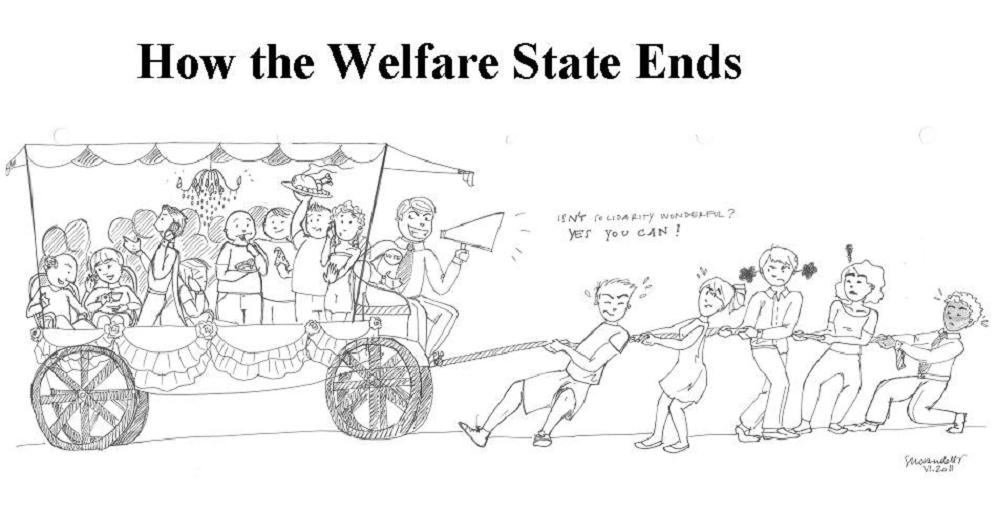
In case you think this is a Democrat vs Republican problem...
“The growth of entitlement spending over the past half-century has been distinctly greater under Republican administrations than Democratic ones. Between 1960 and 2010, the growth of entitlement spending was exponential — but in any given year, it was on the whole over 8 percent higher if the president happened to be a Republican rather than a Democrat. . . . The Richard Nixon, Gerald Ford and George W. Bush administrations presided over especially lavish expansions of the entitlement state.”...which is borne out by the first chart above.
Worst of all, the spending listed above adds enormously to the federal debt, which stands at over $16 Trillion. Our children and grand children will either pay that debt, or worse, default on it. We're robbing them tomorrow to pay people not to work today.
Economist Herbert Stein (father of Ben Stein) said, "If something cannot go on for ever, it will stop". America's welfare state can't go on for ever. It will stop. That is certain. There are only two questions:
When?
How?

No comments:
Post a Comment