Scott Panchick, three-time CrossFit Games competitor and 5th-place finisher in 2014, recently posted a video of himself squatting 500 lb, a new PR for him.
When you film a squat from a relatively high angle, looking down at the athlete, it's often difficult to tell if the athlete lowered his/her hips below the top of the knee, as they should. Scott Panchick's squat dropped so low that its below-parallel depth was easy to see even from the relatively high camera angle.
Mr Panchick lists his weight as 190 lb on the CrossFit Games website. A 263% body weight back squat is an impressive accomplishment, but the reason I posted this here is that I think this example - along with many others - contradicts some criticisms commonly leveled at CrossFit as a training regimen.
The most obvious is that CrossFit keeps people weak. Clearly, Scott Panchick and all other CrossFit Games athletes are far from weak. Yes, they are elite athletes, and therefore not representative of all people who train using CrossFit. However, their programming demonstrates how pretty much anyone can train with CrossFit and get a whole lot stronger. Mr Panchick's training sessions, like those of most CrossFit Games athletes, typically start with a weightlifting movement, followed by some high intensity conditioning. Obviously, few of us would want to employ the level of volume or intensity they do, but if a person scales that kind of program to his/her ability level and progressively increases the load over time, that person could continue to improve for years, just as all CrossFit Games athletes have.
That brings me to the second criticism often leveled at CrossFit. Critics often claim CrossFit only helps novices improve, and that improvement ceases after a few weeks or months of training. Mr Panchick and other CrossFit Games athletes are clearly far from novices, and yet they continue to improve year after year, just as ordinary athletes of all ages in CrossFit gyms all over the world continue to improve year after year. That wouldn't be possible if CrossFit only worked for novices and only for a few weeks or months.
Finally, I'll address one criticism that is accurate, but misses the point. Many who see Mr Panchick's squat will comment that if he focused exclusively on strength training, he'd be even stronger. That is undoubtedly true. It is also true that if a decathlete focused exclusively on the 100 m sprint, or the long jump, or the shot put, or the pole vault, or the 1500 m run, he'd be much better at sprinting, jumping, shot putting, pole vaulting or running 1500 m. But then he could never hope to earn the title of "World's Greatest Athlete".
Likewise, the CrossFit Games does not claim to find the strongest on Earth, but "the fittest on Earth". Fitness is a combination of ten components of which strength is only one. It's the most important one, but it's still only one. Were Mr Panchick to focus exclusively on strength, his competence in the other nine components would decrease. That's fine for a power lifter who is chasing absolute strength exclusively, but not for an athlete who wishes to maximize fitness as a whole.
Mr Panchick comments on his Instagram video that he is also chasing a five minute mile. Think about that. Many people can run a five minute mile. Many can squat 500 lb. How many can do both?
As Rich Froning said upon winning his fourth straight CrossFit Games, "This stuff works".
Monday, September 15, 2014

Monday, August 18, 2014
Matt Chan Takes a Bad Spill
Talk about unknown and unknowable! Multiple-time CrossFit Games athlete, Matt Chan, and his wife Cherie (one of the coaches at my Level 1 course) went on a seemingly benign mountain bike ride and Matt took a spill that almost killed him.
Check out the graphic scene at 4:15!
My favorite quotes from the video:
Check out the graphic scene at 4:15!
My favorite quotes from the video:
Cameraman: You're definitely the most jacked dude on Earth using a walker....
Cherie: That's what the nurses thought, too.
Cherie: My mother-in-law said, "This is why you guys do CrossFit, because when something like this happens - and you never know when it's going to happen - you can bounce right back, because you're so much stronger. Look how much better he can support himself because his upper body is so strong."You got it, Mama Chan.
Thursday, August 14, 2014
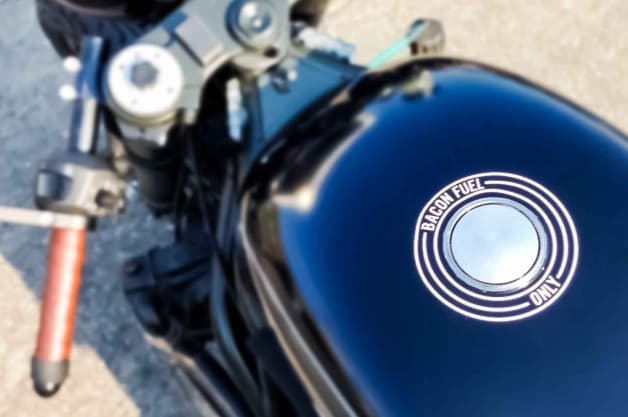
Bacon Powered Motorcycle
I love motorcycles, and I love bacon. How did I not think of this first?
Motorcycles and bacon - what could be better?
 |
| Source: Auto Blog |
The machine started life as an EVA Track T800CDI diesel-powered motorcycle, hailing from The Netherlands, and a bacon-grease conversion was performed by the crew from CSE Engineering, who are accompanying the procession as it crosses the western half of the United States as part of a 12-person team that is filming and documenting the adventure.Here's a series of videos on the bike's and its rider's adventures across the US.
Motorcycles and bacon - what could be better?
Wednesday, August 13, 2014
Indian Scout Engine CAD Drawings
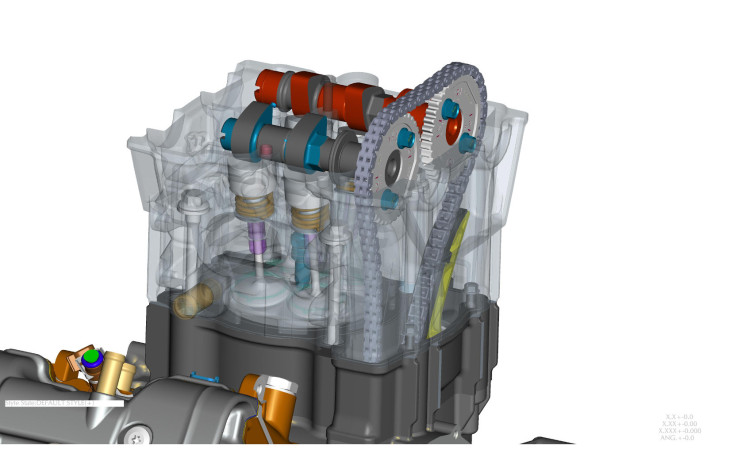
Motorcycle Daily has more CAD drawings of the Indian Scout's 1133 cc, 60-degree V-twin engine.
I don't know Polaris' plans for this engine, but I can think of several exciting possibilities. For example, this engine is somewhat similar to the Rotax-designed 1125 cc V-twin the Buell Motorcycle Company used in the last sport bike they produced before Harley Davidson shut them down. In a higher state of tune, the Scout's engine could easily crank out 125 hp. Polaris could even bore and stroke it out to 1190 cc like Erik Buell Racing did with the old Rotax engine and bump it up to 150 hp or more (EBR's current engine is wholly designed and built by EBR in East Troy, Wisconsin).
Such an engine would be a lot of fun in a sporty standard, or a street tracker, or even an adventure bike. Maybe the Indian name is too wrapped up in history to support such bikes (then again, maybe not), but Polaris could decide to let Indian carry the heritage flag and finally begin to diversify Victory beyond cruisers and onto something more exciting.
 |
| Source: Motorcycle Daily |
 |
| Source: Motorcycle Daily |
I don't know Polaris' plans for this engine, but I can think of several exciting possibilities. For example, this engine is somewhat similar to the Rotax-designed 1125 cc V-twin the Buell Motorcycle Company used in the last sport bike they produced before Harley Davidson shut them down. In a higher state of tune, the Scout's engine could easily crank out 125 hp. Polaris could even bore and stroke it out to 1190 cc like Erik Buell Racing did with the old Rotax engine and bump it up to 150 hp or more (EBR's current engine is wholly designed and built by EBR in East Troy, Wisconsin).
Such an engine would be a lot of fun in a sporty standard, or a street tracker, or even an adventure bike. Maybe the Indian name is too wrapped up in history to support such bikes (then again, maybe not), but Polaris could decide to let Indian carry the heritage flag and finally begin to diversify Victory beyond cruisers and onto something more exciting.
Wednesday, August 6, 2014
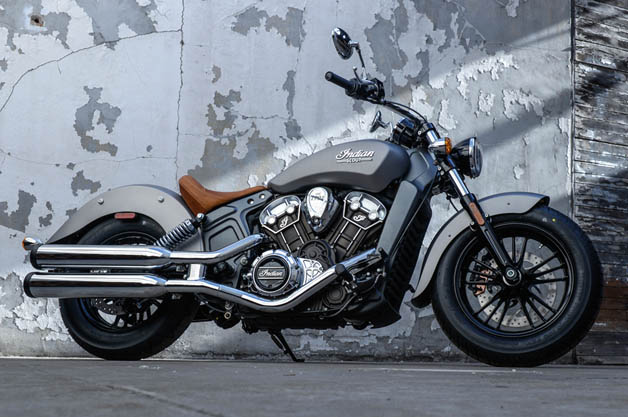
Indian Motorcycles Releases New Scout!
For the second year in a row, I forgot all about Sturgis until it was already going (not that I'd actually attend), and for the second year in a row, the resurrected (for the 5th time?) Indian Motorcycles - now part of Polaris Industries - released a new bike. Last year, it was the Chief. This year, it's the Scout.
Check out these videos from Indian Motorcycle's YouTube channel.
Pretty cool, right? Here's my favorite look for the bike, so far.
Cycle World, Motorcycle Daily and Motorcycle USA (among others, I presume) have all published first ride impressions online, and their reviews are mostly glowing, with only minor nits to pick. The Cycle World review seems to verge on sycophancy, but maybe the bike really is that good.
Just looking at it, you can tell that Indian decided to ride the fence between tradition and high technology. The frame is mostly cast aluminum, as opposed to the traditional tubular steel cradle frames of traditional cruisers. The typical cruiser engine is a narrow-angle V-twin with air cooling and two push-rod-actuated valves per cylinder. The Scout's engine features a 60 degree V angle, liquid cooling, four valves per cylinder, dual overhead cams and a counter-balancer. It doesn't even pretend to be air cooled, like the Harley-Davidson V-Rod with its fake cooling fins. Actually, besides the fake cooling fins, the Scout's engine specs are pretty similar to that of the V-Rod.
Either way, an 1133 cc engine that generates 100 hp at the crank is very lightly stressed, which leaves lots of room for owners and tuners to squeeze a lot more out of it.
In short, it's not as traditional as the Harley-Davidson Sportster (the quintessential American motorcycle), but it's nowhere near as radical as the Ducati Diavel.
The Sportster seems like the Scout's most natural competitor. As far as specs go, the Scout beats the Sportster hands down. It's lighter, more powerful (by 32 hp), generates similar torque and can lean further into a corner.
You can read a more comprehensive list of specs for the Scout here, and for the Sportster here. Unlike most motorcyclists, however, cruiser riders are notoriously impervious to spec sheets. They choose bikes for far more subjective reasons.
The one disappointment about this bike is that - like the Sportster - it doesn't really live up to its own heritage. But then, no bike could. The Scout and the Sportster were the badass sport bikes of their day. They competed in everything from road races, to flat tracks to off road scrambles. And that's why it's impossible for any bike to live up to that heritage. Bikes today are so specialized, that no bike could be converted into both a champion road racer and a champion enduro.
Still, it's a cool bike. At first I thought I wasn't in its target demographic because I don't ride cruisers. But, maybe I am, because this bike might just change my mind. Maybe if they made a street tracker version...
... with this classic look.
The scabbard is key.
 |
| Source: Auto Blog |
Check out these videos from Indian Motorcycle's YouTube channel.
Pretty cool, right? Here's my favorite look for the bike, so far.
 |
| Source: Cycle World |
Cycle World, Motorcycle Daily and Motorcycle USA (among others, I presume) have all published first ride impressions online, and their reviews are mostly glowing, with only minor nits to pick. The Cycle World review seems to verge on sycophancy, but maybe the bike really is that good.
 |
| Source: Motorcycle Daily |
Just looking at it, you can tell that Indian decided to ride the fence between tradition and high technology. The frame is mostly cast aluminum, as opposed to the traditional tubular steel cradle frames of traditional cruisers. The typical cruiser engine is a narrow-angle V-twin with air cooling and two push-rod-actuated valves per cylinder. The Scout's engine features a 60 degree V angle, liquid cooling, four valves per cylinder, dual overhead cams and a counter-balancer. It doesn't even pretend to be air cooled, like the Harley-Davidson V-Rod with its fake cooling fins. Actually, besides the fake cooling fins, the Scout's engine specs are pretty similar to that of the V-Rod.
Either way, an 1133 cc engine that generates 100 hp at the crank is very lightly stressed, which leaves lots of room for owners and tuners to squeeze a lot more out of it.
 |
| Source: Motorcycle Daily |
In short, it's not as traditional as the Harley-Davidson Sportster (the quintessential American motorcycle), but it's nowhere near as radical as the Ducati Diavel.
The Sportster seems like the Scout's most natural competitor. As far as specs go, the Scout beats the Sportster hands down. It's lighter, more powerful (by 32 hp), generates similar torque and can lean further into a corner.
 |
| Source: Motorcycle Daily. Click to enlarge. |
You can read a more comprehensive list of specs for the Scout here, and for the Sportster here. Unlike most motorcyclists, however, cruiser riders are notoriously impervious to spec sheets. They choose bikes for far more subjective reasons.
The one disappointment about this bike is that - like the Sportster - it doesn't really live up to its own heritage. But then, no bike could. The Scout and the Sportster were the badass sport bikes of their day. They competed in everything from road races, to flat tracks to off road scrambles. And that's why it's impossible for any bike to live up to that heritage. Bikes today are so specialized, that no bike could be converted into both a champion road racer and a champion enduro.
Still, it's a cool bike. At first I thought I wasn't in its target demographic because I don't ride cruisers. But, maybe I am, because this bike might just change my mind. Maybe if they made a street tracker version...
 |
| Source: Roland Sands Design |
... with this classic look.
 |
| Source: Wikimedia Commons |

The scabbard is key.
Subscribe to:
Posts (Atom)