Dan Mitchell of Cato presents the facts.
One hopes that the dictator of North Korea suffered greatly before he died. After all, his totalitarian and communist (pardon the redundancy) policies have cause untold death and misery.
But let’s try to learn an economics lesson. In a previous post, I compared long-term growth in Hong Kong and Argentina to show the difference between capitalism and cronyism.
But for a much more dramatic comparison, look at the difference between North Korea and South Korea.

One could make a similar comparison of East and West Germany; same people, same culture, different political and economic systems, vastly different outcomes.
Here's that comparison between Hong Kong and Argentina mentioned in Mitchell's paragraph above.

Argentina used to be one of the wealthiest nations on Earth, but successive "administrations" (if one can call them that) decided to go the route of cronyism. The Argentinian government picks economic winners and losers instead of allowing markets to do so, which is their purpose. Hong Kong, on the other hand, has one of the most free, least regulated economies on Earth, and went from being one of the poorest to among the richest countries (if one can call it that). Do you suppose there's a correlation?
There's more. The following chart compares income growth in Chile, Argentina and Venezuela.
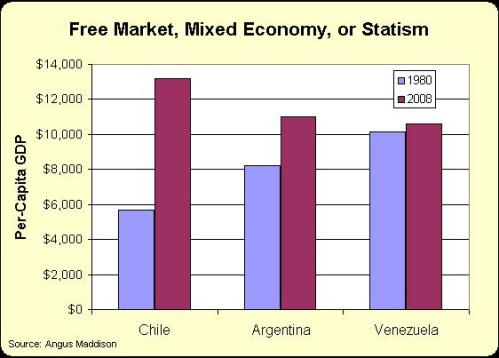
After Pinochet's dictatorship ended, Chile began reforming its economic policies. Today, Chile ranks as the 4th most free economy in the world; embarrassingly ahead of the United States. Consequently, Chile, which used to be the poorest country in the group, is now the wealthiest. Venezuela, which used to be the wealthiest, is now essentially a Communist dictatorship under Hugo Chavez. Consequently, they are now the poorest country in the group. Argentina, which continues its cronyism, is in the middle.
Do you think we could learn a lesson from these comparisons? Do you think we will?

No comments:
Post a Comment