Showing posts with label Energy. Show all posts

Sunday, November 17, 2013

Interview: "The Frackers"

Prof Reynolds interviews WSJ reporter, Gregory Zuckerman, about his new book, "The Frackers".


Do watch the whole thing, but a couple things stood out to me.

First, the fracking revolution could have just as easily taken place in Russia, China, or a number of other places, but instead it happened in the US.  One reason for that is stronger property rights in the US than in other countries.  Most fracking in the US takes place om privately owned land.  In most states, the land owner also owns the mineral rights for his/her land.  That means they can make more money from allowing a fracking firm to drill on their land, which gives the land owner more incentive to do so.

It's a great example of how liberty leads to opportunity, which leads to prosperity.

Second, oil giants like ExxonMobil did not initiate the fracking boom.  Smaller firms, whose wells were drying up and didn't have the resources to explore abroad, were more willing to take risks because, essentially, they had nothing to lose.

Anti-fracking regulations "Liberals" demand wouldn't hurt ExxonMobil, but they would kill those smaller firms.

Unfortunately, no discussion on hydraulic fracturing is complete without addressing anti-fracking hysteria.  It's worth noting, then, that former DOE secretary Stephen Chu, no fan of fossil fuels, stated that fracking...
...is something you can do in a safe way,” former Secretary of Energy Steven Chu said while speaking in Columbus, Ohio, on Sept. 18. He also said that it was a “false choice” to say that the country can either preserve the environment or acquire cheap natural gas.
Former Secretary of the Interior, Ken Salazar, stated that...
“I would say to everybody that hydraulic fracking is safe,” Salazar said during a conference in Las Cruces, N.M. He said that fracking was “creating an energy revolution in the United States.”
Chu and Salazar joined current Secretary of Energy Ernest Moniz, who in early September praised fracking as “a big contributor to our carbon reduction” and “a huge economic benefit.” 
And now the British government has reached the same conclusion.
“There are risks but they can all be mitigated” through monitoring and regulation, Neil Dhot, a spokesman in London, said today by telephone. The report, compiled by an independent consultant, is funded by the water industry, he said.
Everything we do involves risk - even doing nothing.  An honest risk analysis of hydraulic fracturing, I believe, demonstrates that the financial benefits of fracking far outweigh the potential risks.

UPDATE: Speaking of fracking, the Bakken formation of North Dakota & Montana is projected to produce about one million barrels per day next year.


The growth of crude oil production in the Bakken region is part of a longer-term trend in drilling efficiency gains and has led North Dakota to rank second in crude oil production in the United States, behind only Texas.


UPDATE: Prof Reynolds has another outstanding column in USA Today in his series about "the America that works and the America that doesn't", which contrasts the successes of the frackers with the "train wreck" of Obamacare.
As I've written here before, there are two Americas: One that works, produces value, and overcomes problems, and one that for the most part doesn't work, consumes wealth, and produces more problems than it solves. 
The America that doesn't work was very much in evidence this past week, as the Obamacare roll out continued to be -- in Democratic Sen. Max Baucus' memorable phrase -- a "train wreck." Writing in The New Republic, John Judis observed that the Obamacare fiasco should make fans of activist government angry, because it will damage big government's brand for decades to come. Well, if you support big government because you think that politicians are more competent or honest than the rest of us, yes, it's a big bummer. Then again, if you really think so highly of politicians, you have more serious problems than that.
Read the whole thing.

Monday, April 8, 2013

Capitalism is Good for the Environment

Remember the Kyoto Protocol?  It's alright if you don't.  Nobody else seems to.  Which is funny, because "Environmentalists" warned of war, famine, pestilence and death if the world didn't ratify it.  No, seriously.  

Then-VP Al Gore signed the treaty, but the US Senate never ratified it, making it invalid in the US.  Leftists, of course, blamed President Bush, because everything is Bush's fault.  Supposedly, Americans' "Commercialism and greed overcome all common sense and thought for the welfare of future generations. This failure causes hatred not only of the Bush administration, but of American commercialism in general".  Also, the refusal to ratify the Kyoto Protocol was a failure of American leadership in the world.

Sixteen years later, we "greedy" Americans must look more dastardly than ever, right?  Wrong.
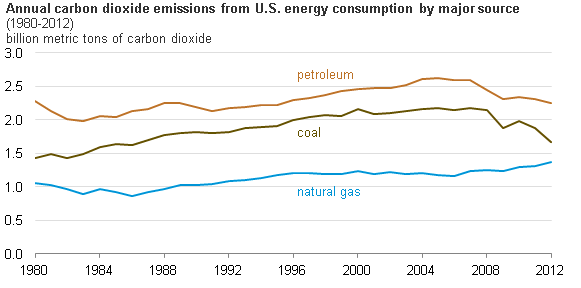
In 2012, a surprising twist and without ever ratifying it, the United States became the first major industrialized nation in the world to meet the United Nation’s original Kyoto Protocol 2012 target for CO2 reductions.
 
How is this possible?  How did we "greedy" Americans succeed in meeting the objectives of the Kyoto Protocol - having never ratified it - while all those virtuous nations that enthusiastically signed the treaty failed?

One word.  Frack.
The largest drop in emissions in 2012 came from coal, which is used almost exclusively for electricity generation (see figure below). During 2012, particularly in the spring and early summer, low natural gas prices led to competition between natural gas- and coal-fired electric power generators. Lower natural gas prices resulted in reduced levels of coal generation, and increased natural gas generation—a less carbon-intensive fuel for power generation, which shifted power generation from the most carbon-intensive fossil fuel (coal) to the least carbon-intensive fossil fuel (natural gas).


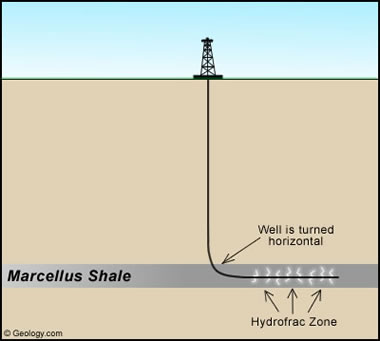
We know that the increased supply of natural gas in the US economy resulted from advances in, and the increased use of, hydraulic fracturing techniques, which unlock reserves that were previously inaccessible.  We also know that hydraulic fracturing (fracking) techniques became economically viable because of the recent increase in energy prices.  Higher prices created an incentive to invest in fracking.  Fracking increased supply, which, along with innovations spurred by competition, resulted in lower natural gas prices, and that prompted energy producers to switch from coal to natural gas.

In other words, free markets succeeded where bloated, collectivist government mandates failed.  In other words, American "greed" turned out to be more virtuous than multinational "virtue". 

There is another, less rosy possible reason why the US's carbon emissions fell since 2007.  The recession began in 2007, and the American economy remains weak.  A weak economy results in reduced energy consumption and demand.  But I don't think that was a major factor here.  After all, Europe's economy is even weaker than that of the US, but all European nations failed to meet their Kyoto goals.

The lesson here is one sensible people learned when they saw the devastation the Soviet Union caused to its environment - free markets work, even in environmental matters.

But don't expect "Environmentalists" to embrace free market solutions to environmental problems.  "Environmentalists" are, for the most part, watermelons - green on the outside, red on the inside.  Environmental concerns are an excuse for them to give government even greater power over people's lives.  No matter how well free market solutions prove to work, most "Environmentalists" will always reject them, because their main concern is not the environment.  Their main concern is bloated, morbidly obese, inescapable government.

Monday, November 19, 2012

Throwing Good Money After Bad

The federal government's insistence on wasting money on "green energy" companies has achieved self-parody.
Energy Secretary Steven Chu at A123 Systems
Electric car battery maker A123 Systems received a $946,830 check from the U.S. Energy Department on the day it filed for Chapter 11 bankruptcy last month -- providing more ammunition for critics who say the Obama administration is blindly funding failed clean energy companies.

The Waltham, Mass.-based company also told two U.S. senators in a letter this week that it may seek more money from the $249.1-million Energy Department stimulus award it won in 2009. A123's Oct. 16 check was the latest payment as part of the original grant, which is distributed incrementally as the company meets certain benchmarks. A123 has received $133.3 million of the grant so far based on its investments in new battery plants in Livonia and Romulus, Mich.
You know what we really need in this roaring economy?  We need the federal government to take our money and give it to politically connected loser companies in the administration's pet industries.

Who do you think makes more productive financial decisions with your money; you, or DC politicians and bureaucrats?

Remember, governments don't pick winners and losers.  They only picks losers, because winners don't need governments to prop them up with money confiscated from tax payers.

Saturday, November 17, 2012

Saudi Dakota? (Updated)

The US economy may be stagnant, but North Dakotans haven't noticed.  Recession?  What recession?
The “Economic Miracle State” continues to lead the nation with the lowest state unemployment rate at 3% in September, at almost five percentage points below the national average of 7.8%.  There were 11 North Dakota counties with jobless rates below 2.0% in September, and Williams County, which is at the epicenter of the Bakken oil boom, continues to boast the lowest county jobless rate in the country at just 0.7%.  The exponential growth in North Dakota oil production has fueled exponential growth in the state’s oil and gas jobs, which have more than tripled over the last three years.  Overall employment throughout the entire state increased 5.6% over the twelve month period through September; four times the tepid 1.4% pace of job growth nationally during that period.
It ain't no miracle.  It's a deliberate decision to allow free market forces to work and create wealth by accessing the state's natural raw materials, namely petroleum.
What’s especially impressive is the incredible exponential increase in North Dakota’s oil production over such a short period of time.  The state’s oil production has doubled in just the last 16 months, from 364,160 bpd in May of last year to 728,494 in September of this year.  Oil coming out of the state’s Bakken Formation is behind the huge increase, as that oil field in western North Dakota now supplies 91% of the state’s oil, up from only 78% of the state’s oil two years ago.  Bakken oil output has doubled in just the last 15 months, from 320,435 bpd last June to 662,428 bpd in September (see bottom chart above).  At the current pace of production increases, North Dakota’s oil production will surpass one million bpd by the end of next year.  And it’s the exponential increases in shale oil production in the Bakken region of North Dakota and the Eagle Ford Shale region of Texas that have the United States on a trajectory to become the world’s largest oil producer in the next eight years.


Considering North Dakota's economic boom due to "frackin' the Bakken", and that the US has more petroleum in the Green River Formation than all the world's known oil reserves, the federal government must be eager to allow more drilling and exploration on federal lands, right?

The Interior Department on Friday issued a final plan to close 1.6 million acres of federal land in the West originally slated for oil shale development.

The proposed plan would fence off a majority of the initial blueprint laid out in the final days of the George W. Bush administration. It faces a 30-day protest period and a 60-day process to ensure it is consistent with local and state policies. After that, the department would render a decision for implementation.
As I wrote before, "it's not as though, in this roaring economy, we need all that inexpensive energy or high-paying jobs".

The US is over $16,000,000,000,000 in debt and counting.  The federal government added over $120,000,000,000 to that debt in October 2012 alone and is on track to add another $1,320,000,000,000 to the debt by the end of fiscal year 2013.  Raising taxes will likely cause the economy to slow even more.  Even if the federal government were to cut spending drastically (good luck with that), we would need enormous economic growth to begin paying down our monstrous debt.

In other words, we need the kind of growth North Dakotans have enjoyed for years.

UPDATE (19NOV2012): The following charts demonstrate how hydraulic fracturing (fracking) has increased total US reserves of petroleum and natural gas by making previously unavailable reserves available.  Further technological advances will make the Green River Formation available.

From the Energy Information Administration

Sunday, November 11, 2012

Energy: Told You So

Pres Obama likes to take credit for the increase in petroleum and natural gas production in the US over the last four years.  What he leaves out is that, as Mitt Romney pointed out during the debates, the Obama administration cut drilling permits on federal lands by 36%.  The increase comes from private and (some) state lands.  Now that he doesn't need to run for re-election, Pres Obama plans to cut federal drilling permits even further.
The Interior Department on Friday issued a final plan to close 1.6 million acres of federal land in the West originally slated for oil shale development.

The proposed plan would fence off a majority of the initial blueprint laid out in the final days of the George W. Bush administration. It faces a 30-day protest period and a 60-day process to ensure it is consistent with local and state policies. After that, the department would render a decision for implementation.
It's not as though, in this roaring economy, we need all that inexpensive energy or high-paying jobs.  In fact, it's probably a good thing that the layoffs have already started in the icky energy sector.
A Utah coal company owned by a vocal critic of President Barack Obama has laid off 102 miners.

The layoffs at the West Ridge Mine are effective immediately, according to UtahAmerican Energy Inc., a subsidiary of Murray Energy Corp. They were announced in a short statement made public Thursday, two days after Obama won re-election.

The layoffs are necessary because of the president's "war on coal," the statement said. The slogan is one used frequently during the election by Murray Energy CEO Robert Murray, who was an ardent supporter of Republican presidential candidate Mitt Romney.

In its statement, UtahAmerican Energy blames the Obama administration for instituting policies that will close down "204 American coal-fired power plants by 2014" and for drastically reducing the market for coal.
"There is nowhere to sell our coal, and when we can, the market prices are far lower," the statement said. "Without markets, there can be no coal mines and no coal jobs."
Then-Sen Obama did promise in January 2008 that his policies would "bankrupt" coal power plants and cause energy prices to "necessarily skyrocket".  So credit him with one promise kept.

Sunday, November 4, 2012

Gadsten Flag on a Coal Barge

From the Chicago Boyz:
Here is a coal barge on the Ohio River, today.

I note that they are flying the Gadsden flag.

I hope they and their families, and other like-minded folks in Ohio and Pennsylvania, vote to end the self-inflicted war on American energy production.

Thanks to ChicagoBoyz reader Bob Skinner for the picture. Bob half-expected our Commander in Chief to call in a drone strike on these guys, partly for the yucky coal, but mostly for the flag.